
Trump’s “New Deal”?
The storm is upon us — the elite parasites are going nuts

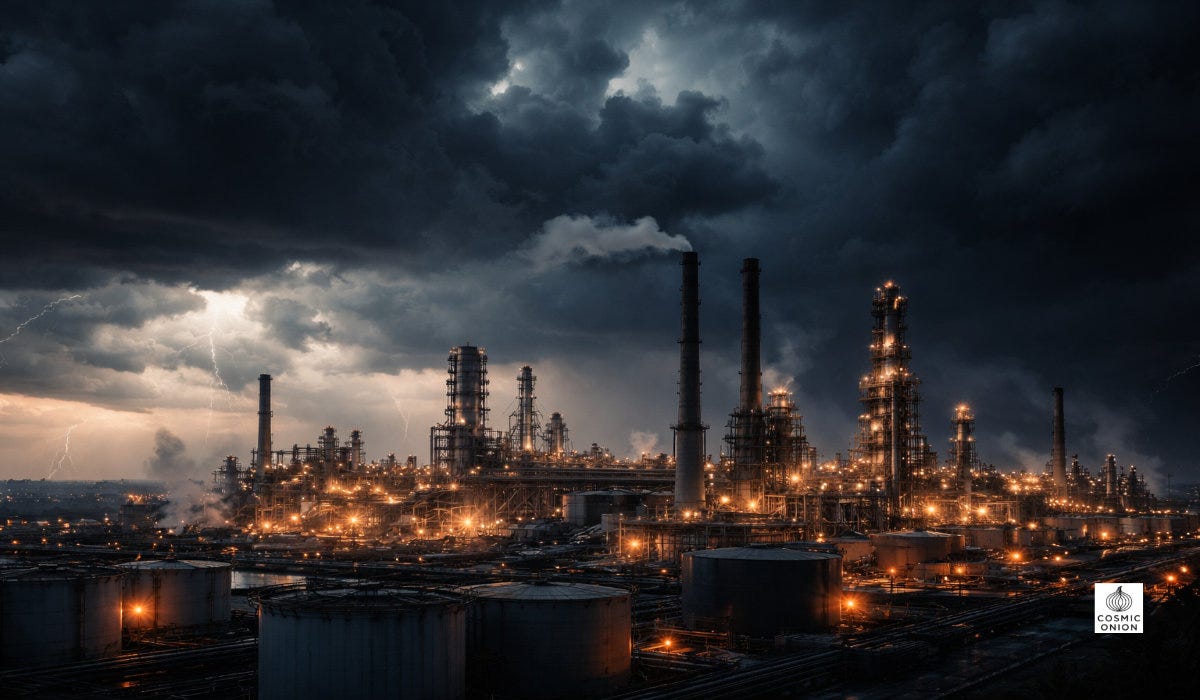
Not because Trump is brilliant.
Not because he’s benevolent.
But because the ground is moving — and the old tricks no longer work.
Something is breaking beneath the narrative layer, and everyone who lives off that layer can feel it. The elites aren’t panicking because of a man. They’re panicking because the system that made people like them powerful is losing traction.
Call it Trump’s “New Deal” if you want.
Just don’t confuse it with Roosevelt’s.
This isn’t about saving people.
It’s about keeping the system producing.
1. This Is Not a Political Moment — It’s a Structural One
Politics is the costume.
Structure is the body underneath.
When governments flirt with shutdowns, banks wobble, liquidity tightens, and paper markets suddenly dump years of fictional supply in a matter of hours, you are not watching ideology clash.
You’re watching load limits being hit.
The system is over-levered, over-promised, and under-collateralized. It runs on confidence, not substance — and confidence becomes very expensive when:
debt costs real interest again
supply chains stop behaving
energy stops being cheap
people stop trusting abstractions
At that point, the only thing that matters is control of physical flow.
Everything else is noise.
2. The Old Deal Was Paper. This One Is Physical.
The post-1971 deal was simple:
financialize everything
offshore production
turn labor into debt
turn debt into derivatives
call it growth
It worked as long as trust was infinite and energy was cheap.
That era is over.
What’s replacing it isn’t pretty, moral, or democratic. It’s industrial triage. (See Addendum)
Trump doesn’t talk like an economist because this isn’t an economic plan. It’s a survival posture for a declining empire trying to re-anchor itself in matter.
Steel.
Energy.
Factories.
Transport.
Food.
Defense.
You can’t print those.
3. Why the Elites Are Losing Their Minds
The managerial class thrives on abstraction:
ESG scores
compliance regimes
credential hierarchies
financial engineering
narrative authority
They don’t build things. They regulate, tokenize, and extract.
A shift toward production threatens them because production doesn’t need them.
A factory answers to physics.
An oil well answers to geology.
A supply chain answers to timing and fuel.
There’s no committee vote that overrides reality.
So when you see media meltdowns, legal spasms, moral panics, intelligence-community leaks, and hysterical overreaction, that’s not resistance to Trump.
That’s fear of irrelevance.
4. Venezuela: Energy Gravity, Not Humanitarian Theater
Venezuela isn’t important because of democracy, elections, or sanctions theater.
Venezuela matters because it sits on energy gravity — massive oil reserves in a world where energy scarcity is once again politically lethal.
When systems are stable, energy politics stay polite.
When systems crack, energy becomes strategic again.
Watch behavior, not headlines:
sudden softening of sanctions
quiet negotiations
reframing of “bad actors”
rapid shifts in media tone
That’s not moral awakening. That’s triage.
Because when energy costs drop, inflation narratives collapse, production restarts, and leverage shifts away from paper intermediaries.
Cheap energy isn’t an environmental issue.
It’s a system breaker.
5. The “Secret Weapons” Narrative — What It Really Signals
Whenever systems lose control, rumors appear.
Silent helicopters.
Directed energy weapons.
Invisible technologies.
Unacknowledged capabilities.
People dismiss these as fantasy — and miss the point.
These stories don’t spread because people are stupid.
They spread because intuition senses asymmetry.
The real “secret weapons” are not sci-fi beams frying targets from the sky. They are capabilities that bypass legacy control structures.
And the most dangerous one of all is cheap, abundant energy.
6. Directed Energy, Silent Machines, and Psychological Warfare
Let’s be precise…
There are classified programs.
There are black-budget systems.
There are technologies the public doesn’t see.
But the reason DEWs and “silent helicopters” enter the conversation isn’t because they’re being used everywhere.
It’s because they symbolize power without narrative permission.
Silent influence.
Invisible leverage.
Effects without announcements.
That’s what terrifies bureaucracies.
Because bureaucracies survive on process visibility.
They die when outcomes appear without explanations.
7. The Real Directed Energy Weapon Is Energy Itself
Here’s the inversion most people miss:
The most disruptive weapon on Earth is not a laser.
It’s cheap energy.
Cheap energy:
lowers prices without rate hikes
collapses inflation narratives
revives domestic production
breaks debt dependency
weakens adversaries structurally
Every empire in history collapses when energy costs rise faster than productive output.
Every rebuild starts by forcing energy back down.
This is why oil, gas, nuclear, and “forbidden” energy discussions suddenly reappear when systems wobble.
It’s not ideology.
It’s physics.
8. The Silver Signal: When Reality Leaks Through
Silver tells the truth faster than almost anything else because it sits at the intersection of:
money
energy
industry
technology
When nearly two billion ounces of paper silver trade in a single day — in a world that produces less than half that in a year — that’s not a market.
That’s containment.
Paper silver is dumped to:
suppress fear
provide collateral liquidity
shake weak hands
maintain the illusion of control
Meanwhile, physical silver:
disappears
premiums detach
delivery times stretch
dealers quietly suspend activity
Paper clears panic.
Physical clears reality.
Reality is winning.
9. Paper Markets Are Buying Time — And Burning Trust
Every paper intervention buys time.
Every intervention also burns trust.
You don’t smash markets that don’t matter.
You don’t cap prices that aren’t dangerous.
You don’t dump imaginary supply unless real supply is gone.
The louder the suppression, the weaker the structure underneath.
This is why interventions keep getting larger and less effective.
They’re fighting a one-way flow.
When real assets leave the market, they don’t come back.
10. Trump’s “New Deal” Isn’t Moral — It’s Mechanical
Roosevelt’s New Deal expanded bureaucracy to manage people.
This one strips bureaucracy to manage flows.
It doesn’t promise safety.
It promises capacity.
It doesn’t promise fairness.
It promises function.
And it doesn’t care who gets offended, displaced, or bankrupted along the way — because systems under stress don’t negotiate.
They shed load.
11. Why the Elites Are Panicking Now
Because this shift removes their primary advantage: narrative control.
You can’t regulate physics.
You can’t credential energy.
You can’t ESG your way out of scarcity.
And you definitely can’t paper over reality forever.
The more the system leans on abstraction, the more brutal the reversion becomes.
That’s what you’re seeing right now.
12. Clif’s Floaty RV
(And Why It Freaks People Out)
The joke about Clif High’s floaty RV isn’t about UFOs.
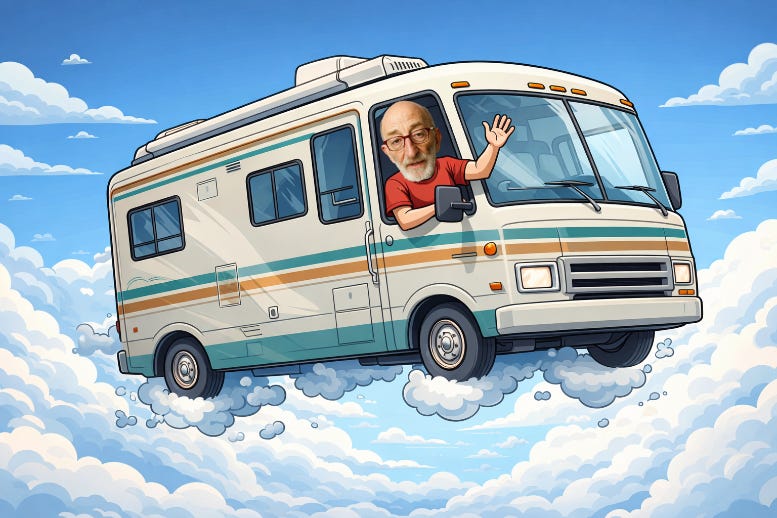
It’s about energy sovereignty.
A world where energy becomes cheap, localized, and uncontrollable by centralized systems is a world where:
debt leverage collapses
bureaucratic permission loses power
sovereignty migrates downward
control evaporates
That’s why fringe free energy stories never die.
They don’t need to be true yet.
They just need to be plausible enough to haunt the system.
13. This Is Why Suppressed Tech Keeps Reappearing
Every collapse phase produces the same patterns:
forbidden energy rumors
sudden rediscovery narratives
“lost” technologies
mysterious capabilities
Not because they’re all real — but because people sense the old limits dissolving.
The system taught us scarcity was natural.
It isn’t.
It was enforced.
14. What Happens Next (No Predictions)
This isn’t a forecast.
It’s a pattern.
Expect:
volatility sold as stability
paper volume masking physical scarcity
louder narratives, thinner reality
sharper elite reactions to loss of control
And expect this above all:
When trust finally breaks, it doesn’t fade.
It vanishes.
15. The Real Question
The question isn’t whether Trump has a New Deal.
The question is whether any political figure can steer a system already past its design limits.
Because once the storm is upon you, leadership doesn’t create calm.
It decides:
who gets lifeboats
who gets ballast
and who gets thrown overboard
That’s what the elites are reacting to.
Not Trump.
Not voters.
Not ideology.
But the realization that the age of paper authority is ending, and reality has started issuing invoices again.
They’re not ready.
Some of us are.
Addendum: Industrial Triage
One phrase keeps surfacing beneath the noise, and it’s worth naming plainly.
Industrial triage.
This is not growth policy.
It’s not reform.
It’s not compassion.
Industrial triage is what happens when a system can no longer save everything — and stops pretending it can.
The term comes from battlefield medicine. When resources are scarce and the situation is unstable, you don’t treat everyone equally. You stop the bleeding. You preserve what can still function. You let non-viable cases go.
That same logic is now being applied to the real economy.
Not in speeches.
Not in legislation.
But in behavior.
What gets prioritized is revealing:
energy production
grid stability
fuel access
core manufacturing
logistics and throughput
strategic materials
These are the organs that keep the system alive. Without them, nothing else matters — not finance, not services, not narratives.
What gets quietly abandoned is just as telling:
financial excess
zombie companies
speculative leverage
compliance theater
credential hierarchies
paper claims detached from production
No announcements.
No moral framing.
No apologies.
Just silent decisions about where limited energy, capital, and attention still produce real output.
This is why policies flip overnight.
Why sanctions soften without explanation.
Why paper markets get abused.
Why metals are suppressed.
Why energy suddenly “matters again.”
The system no longer has infinite liquidity, infinite trust, or infinite time.
So it has shifted from asking:
“How do we keep everyone calm?”
to:
“What still actually works?”
That shift terrifies elites who live entirely in abstraction. Triage doesn’t care about status, credentials, or narrative authority. It answers only to physics and function.
This is also why Trump fits the moment — not because of ideology or virtue, but because industrial triage doesn’t require elegance. It requires blunt sorting.
Does it produce?
Does it move?
Does it power something real?
Does it keep the lights on?
If yes — keep it alive.
If no — cut it loose.
Once triage begins, the illusion of universal protection ends. And there is no going back to pretend abundance after that.
What we are witnessing now is not chaos.
It is selection.


References
Clif High — Substack Essays & Videos
Walter Russell — The Nature of Reality
Richard Berry — Supreme Consciousness Is Primary



—
My father used to say something like:
“They (elites, governments) are over here doing "this and that" while keeping the people distracted over there with food and entertainment — concerts, film and TV, sports (the Olympics, the Super Bowl and World Series) — plus headlines and nonstop noise. Most people won’t know what hit them until it’s too late. And that, my dear daughter, is by design. Don’t you ever forget it.”
Then my dad would shake his head and go back to reading a book, magazine, or newspaper while finishing a pot of coffee.
When I was younger, I thought he was nuts… and too strict (he was ex-military). My dad would even say things like, “What the blank are you going to do if your mother and I die today? How will you survive?” Harsh? Maybe. But it sank in. It pushed me to be as self-sufficient, self-reliant, and independent as possible while realizing I may require the assistance of others. We could help and support each other.
All-in-all, I’m grateful my subconscious was listening in the background and taking notes — because way too much of what my father warned about has come true.
That’s pretty frickin’ scary.
Great, others use words, you paint pictures. Insightful, informative read.