

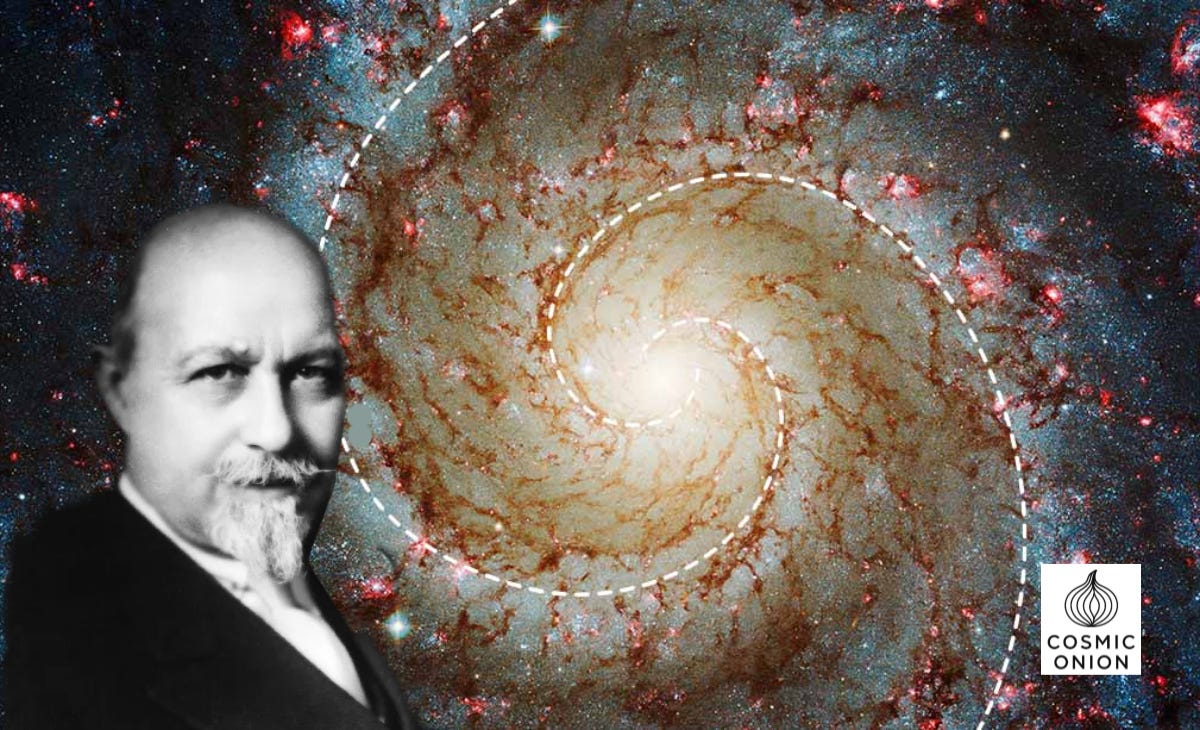
The Nature of Reality —
Russell solved the problem science still circles.
Most people think progress moves forward.
Walter Russell knew it moves in waves.
Walter Russell believed empty space wasn't really empty. Modern physics keeps discovering that “empty” space is considerably stranger than the word suggests.
He knew science wasn’t discovering reality — it was circling it, blindfolded.
He knew matter wasn’t solid — it was slowed light.
He knew electricity wasn’t dead — it was mind in motion.
And he knew humanity would take centuries to catch up.
Walter Russell didn’t predict the future.
He remembered it.
1. The Man Who Stepped Outside Time
In 1921, Walter Russell withdrew from the world and entered what he described as a 39-day illumination — not a trance, not a dream, not a religious conversion. A sustained state of total knowing.
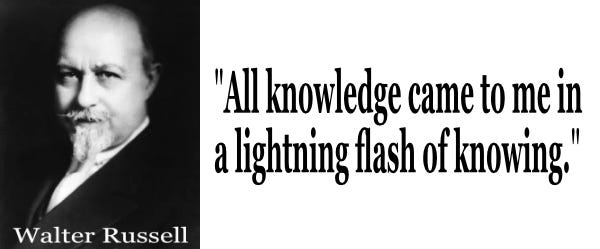
When he came out, he wasn’t speaking in metaphors.
He was speaking in mechanics.
He claimed direct access to what he called the Universal One — the still center behind all motion. From that stillness, he said, came every wave, every atom, every star, every thought.
Russell wasn’t trying to be mystical. He was trying to be exact.
That’s why he confused everyone.
Science didn’t know what to do with someone who spoke like a physicist but rejected particles.
Religion didn’t know what to do with someone who spoke of God but rejected worship.
Spiritual movements didn’t know what to do with someone who refused belief and insisted on law.
So Russell was quietly set aside.
Not attacked.
Not debated.
Just… ignored.
That’s what happens when you’re too early.
2. Light Is Not a Metaphor
Russell’s central claim was simple and devastating:
Everything is light.
Not metaphorically.
Not poetically.
Literally.
Matter, he said, is light compressed into form by wave motion. Atoms are not “things” — they are events. Temporary spiralings of light around a still magnetic center.
This is where Russell split permanently from mainstream physics.
Physics treats light as a phenomenon.
Russell treated it as the substance of reality.
To him, mass was an illusion of compression. Solidity was an illusion of balance. Time was an illusion created by rhythmic motion.
Nothing moved forward.
Everything moved out and back.
Creation was not an explosion.
It was a breath.
3. Motion Is Mind Thinking
Russell’s most dangerous idea wasn’t about light.
It was about mind.
“All motion is mind thinking,” he wrote — and he meant it literally.
Electricity, in Russell’s cosmology, is not a force. It is intelligent motion. The universe does not run on dead mechanics. It runs on awareness expressing itself through polarized waves.
Modern science calls the background of reality “empty space.”
Russell called it the zero of stillness — a living fulcrum from which all motion springs.
Thought is not produced by brains.
Brains are produced by thought.
That single reversal puts Russell outside nearly all modern frameworks.
It also explains why his work remains radioactive.
4. The Spiral, Not the Line
Russell rejected linear time entirely.
To him, time was spiral motion — repetition at higher or lower octaves. Creation unfolds, returns, unfolds again. Birth and death are not beginnings or endings. They are compressions and decompressions of light.
There is no progress.
There is only balance regained.
Civilizations rise, peak, collapse, and return — not because of moral failure, but because imbalance always corrects itself.
This is why Russell saw war, scarcity, and collapse as symptoms — not causes. Humanity wasn’t evil. It was out of phase with cosmic law.
Fix the law alignment, and the symptoms vanish.
That was his wager.
5. Balance Is the Only Reality
Good and evil? Illusions of imbalance.
Life and death? Two halves of one wave.
Creation and destruction? The same motion viewed from opposite sides.
Russell insisted the universe seeks equilibrium at every level — atomic, biological, planetary, civilizational.
When imbalance grows too large, collapse is inevitable. Not as punishment. As correction.
Healing, in this view, is not miraculous.
It is mechanical.Disease is imbalance.
Health is balance restored.
This is why Russell believed medicine, as practiced, was fundamentally backward. It treated effects instead of causes, symptoms instead of wave relationships.
He believed true healing would eventually be achieved through understanding light, rhythm, polarity, and rest — not chemicals.
That future has not arrived yet.
But it’s closer than it was in 1921.
6. Why Science Couldn’t Accept Him
Russell didn’t fit the machine.
He was self-educated.
He rejected authority.
He refused credentials.
He claimed direct knowing.
Worst of all, he said scientists were studying effects while ignoring cause.
Science measures motion.
Russell studied the stillness behind it.
That made him unpublishable, untestable, and unclassifiable.
He wasn’t wrong by their standards — he was irrelevant to them.
And irrelevance is the fastest way to bury a truth.
7. Why Religion Couldn’t Accept Him Either
Russell believed in God.
But not a God that wanted worship, obedience, or sacrifice.
His God was law itself — impersonal, intelligent, perfectly balanced.
There was no sin.
No savior.
No priesthood.
There was only alignment or misalignment with cosmic law.
That left no role for intermediaries.
So religion quietly turned away.
8. The Crime of Being Too Early
Russell believed humanity could eliminate war.
He believed elements could be transmuted.
He believed energy was abundant and free.
He believed education could be rebuilt from first principles.
Not through belief.
Through understanding.
That was the real problem.
Russell didn’t offer comfort.
He offered responsibility.
He told humanity it was participating in its own suffering by misunderstanding reality.
That message never sells well.
9. Why He Matters Now
Today, physics speaks of wave functions, fields, zero-point energy, and observer effects.
Biology speaks of coherence and resonance.
Consciousness research admits it has no idea where awareness comes from.
Every discipline is circling the same center Russell described — the still point behind motion.
We’re not proving Russell right.
We’re catching up.
Slowly. Reluctantly. Unwilling to admit how far behind we really are.
10. The Quiet Truth
Walter Russell was not a prophet.
He was not a guru.
He was not a mystic entertainer.
He was a cartographer.
He mapped a reality humanity was not ready to navigate.
A century later, we’re finally stumbling onto the same terrain — using different language, worse maps, and a lot more noise.
Russell knew this would happen.
That’s why he wrote anyway.
Final Thought
Walter Russell didn’t belong to science.
He didn’t belong to religion.
He didn’t belong to metaphysics.
He belonged to reality.
And reality, unlike institutions, is patient.
Addendum:
What Most People Never Learn About Walter Russell
The public version of Walter Russell is incomplete.
Not wrong — just unfinished.
What’s usually presented is the philosopher, the cosmologist, the man of illumination. What’s quietly omitted is that Russell didn’t stop at explanation. He tried to build a different civilization.
That’s where things get uncomfortable.
Russell’s Energy Devices:
Not “Free Energy,” but Balanced Power
Walter Russell did not believe in “free energy” as the term is commonly used.
He rejected the idea outright.
In Russell’s cosmology, nothing is free. Everything is balanced.
Energy, he said, is not created or consumed. It is borrowed from stillness through motion and returned to stillness through rest. Nature does not burn fuel. It compresses and decompresses light.
Based on this understanding, Russell designed power systems that were:
Centripetal, not explosive
Rhythmic, not consumptive
Aligned with natural wave motion
These devices were intended to produce enormous power with minimal input by working with the universal wave field instead of fighting it.
Russell believed combustion-based energy was a primitive mistake — violent, wasteful, and inherently destructive. True power, he said, would be quiet, cool, abundant, and non-polluting.
He wasn’t speculating.
He was engineering.
The Periodic Table Was Wrong — And He Rebuilt It
Russell also rejected the conventional periodic table.
To him, it was a snapshot of effects without understanding cause.
He reorganized the elements according to:
Wave motion
Octaves of compression
Rhythmic cycles of matter forming and dissolving
In Russell’s system:
Elements are not fixed
Matter can be grown, not mined
Transmutation is a lawful process of wave balance, not an occult fantasy
This wasn’t mysticism. It was cosmology applied to chemistry.
If taken seriously, Russell’s model dissolves the myth of material scarcity at its root.
Which may explain why it was never adopted.
Education: Teaching Cause Before Effect
Russell believed humanity’s deepest failure was educational.
Modern schooling, he argued, trains people to memorize effects while remaining blind to cause. It teaches fragments instead of principles, answers instead of understanding.
He proposed an entirely different foundation:
Teaching wave motion before mathematics
Teaching balance before force
Teaching perception before memorization
Children, Russell believed, should be taught how reality works before being taught how to manipulate it.
This alone would have rewritten civilization within a generation.
It was never attempted.
Lao Russell: The Anchor, Not the Footnote
Walter Russell did not work alone.
His wife, Lao Russell was essential to the transmission of his work — not as a muse or assistant, but as a stabilizing intelligence. She helped translate illumination into language, structure, and practical continuity.
Without Lao, Russell’s work might never have reached the world at all.
Any honest accounting of Walter Russell includes her.
Why None of This Was Adopted
There is no need for conspiracy language here.
The facts are sufficient.
Russell’s work:
Eliminated energy scarcity
Undermined materialism
Removed the need for priesthoods — scientific or religious
Required personal responsibility and understanding
Systems built on scarcity, hierarchy, and authority do not adopt ideas that dissolve their foundations.
So Russell was not attacked.
He was bypassed.
History is full of such figures.
Closing Note
Walter Russell didn’t just describe reality.
He tried to align civilization with it.
That attempt failed — not because it was wrong, but because humanity wasn’t ready to live without its precious illusions.
We may be closer now.
Or we may simply be better at avoiding the implications.
Either way, the map still exists.
And reality hasn’t changed.


References
Clif High — Substack Channel Forecasting
Walter Russell — How Reality Actually Works
Walter & Lao Russell — The Message of the Divine Iliad
Richard Berry — Consciousness Is Primary
Walter Russell — The Universal One


As always, the wolf distills these gems so that the cubs can get these crumbs digested and assimilated. A new pack arises!
Thank you so much for this. Totally new to me- a new field of engagement for me.