
Tom Sawyer
Common Sense, Consciousness, and the Oldest Trick in the Book

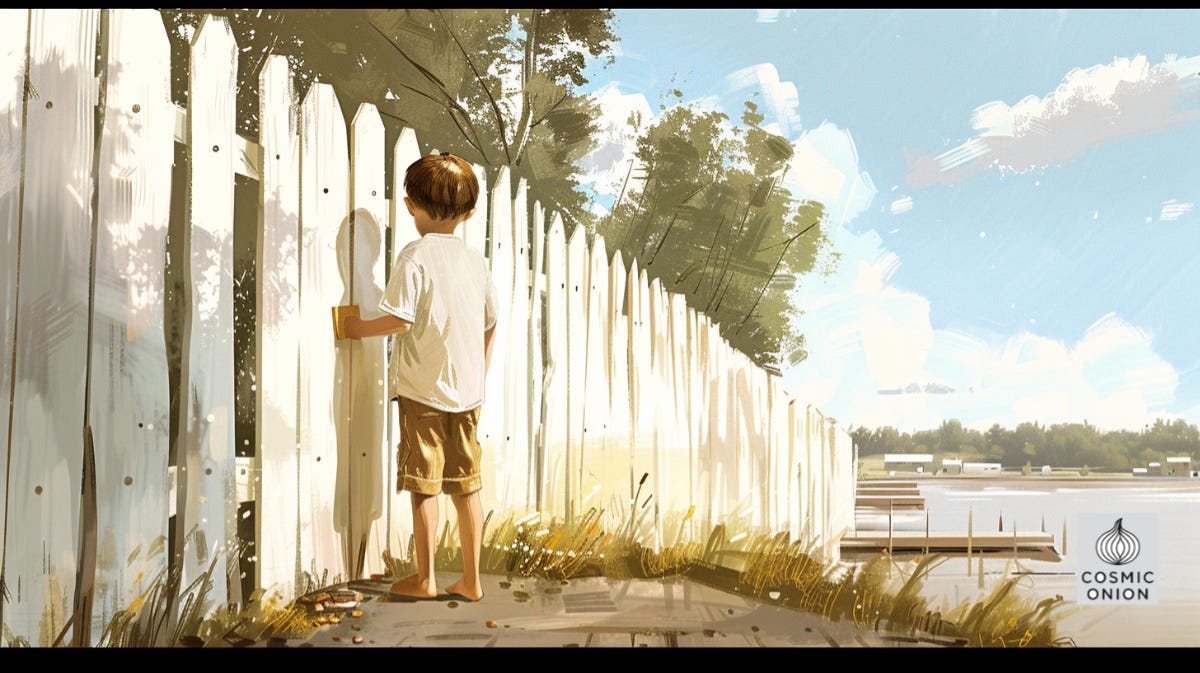
Most people remember Tom Sawyer as a harmless children’s story. A bit of nostalgia. A boy on a river. Whitewashed fences and barefoot summers. Something safe.
That’s a mistake.
Tom Sawyer is not a children’s story. It’s a field manual. A quiet exposure of how systems work, how people are recruited into their own confinement, and how power survives without force.
Mark Twain didn’t write a fantasy. He wrote an observation.
And it still applies…
1. The Fence
The fence is the whole book.
Tom is punished and ordered to paint it. This matters. He doesn’t volunteer. He doesn’t choose the task. It is imposed.
At first, it is exactly what it looks like: dull, repetitive labor enforced by authority.
Then Tom does something subtle.
He doesn’t rebel.
He doesn’t refuse.
He doesn’t argue.He reframes.
He behaves as if painting the fence is not work but privilege. He treats it as an exclusive activity. He guards it. He performs enjoyment, but not in a cartoonish way—just enough to make it look valuable.
And something extraordinary happens.
People want in.
They don’t need to be convinced. They persuade themselves. They beg to paint the fence. They trade for the opportunity. They give Tom their apples, marbles, toys, and time.
The system has flipped.
What began as forced labor becomes voluntary participation. Enforcement is no longer required. The fence paints itself…

This is the oldest trick in civilization.
No whips.
No chains.
No visible violence.
Just belief.
2. Why This Still Works
If this trick were obvious, it wouldn’t work anymore. The reason it still works is because it doesn’t feel like coercion.
People believe they are choosing.
They believe:
Hardship equals virtue
Participation equals belonging
Effort equals meaning
The fence is not sold as obedience. It’s sold as identity.
Modern society is one long fence.
People queue up to:
Work jobs that hollow them out
Defend systems that exploit them
Argue online for institutions that don’t know they exist
Police one another for free
And they don’t feel enslaved. They feel important.
The moment people believe the fence defines their worth, they will fight to paint it.
3. Authority Without Substance
One of the quiet genius moves in Tom Sawyer is how authority figures are portrayed.
They aren’t monsters.
They aren’t masterminds.
They aren’t impressive.
They are hollow.
Teachers rely on routine.
Judges rely on ceremony.
Preachers rely on repetition.
Parents rely on habit.
No one is deeply in control. Everyone is performing a role.
This matters.
Real power doesn’t shout. It doesn’t need to. It only needs people to keep showing up and acting their parts.
Twain understood something most political theories miss:
Authority collapses the moment people stop taking it seriously.
Not violently.
Not dramatically.
Just quietly.
4. Tom vs. Huck
Tom Sawyer and Huck Finn are often lumped together, but they are not the same archetype.
Tom is clever within the system. Huck lives outside it.
Tom wants approval. He wants recognition. He wants to be seen as good, brave, admired.
Huck wants space. He wants freedom. He wants to be left alone.
Tom manipulates the fence. Huck walks past it.
This is crucial.
Most people are not ready to be Huck. Huck pays a price. He is dirty, judged, unwanted. Society tolerates Tom because Tom still plays the game—even when he bends it.
Huck doesn’t play.
That makes him dangerous.
The system can absorb Tom.
It cannot absorb Huck.
This is why truly sovereign people are always framed as irresponsible, lazy, antisocial, or broken. Freedom that doesn’t ask permission is intolerable to organized control.
5. Education as Fence-Painting
Modern education is a perfect fence.
Children enter curious, embodied, playful. They learn by touching, asking, trying, failing.
Then they are trained to sit still, repeat, comply, and perform understanding instead of discovering it.
They are rewarded for painting the fence neatly.
They are punished for asking why the fence exists.
Eventually, many forget they ever questioned it.
The tragedy isn’t ignorance. It’s misdirected intelligence—bright minds spending their lives perfecting brush strokes on someone else’s fence.
Twain saw this before standardized schooling finished its work.
6. The Physics Beneath the Parable
There’s a simple truth beneath all of this, and you don’t need equations or mysticism to see it.
Energy follows attention.
What you repeatedly give your attention to gains momentum. What you withdraw attention from withers.
The fence only matters because people care.
Tom doesn’t force anyone. He redirects attention. Once attention shifts, effort follows naturally.
This is not manipulation in the cartoon sense. It’s observation of how reality actually behaves.
Systems don’t survive on strength. They survive on participation.
7. Why Fighting the Fence Fails
Many people think resistance means fighting harder.
That’s a mistake.
If you argue endlessly about the fence, you are still oriented toward it.
If you rage at the fence, you energize it.
If you obsess over who built it, you keep it central.
The fence feeds on attention, whether positive or negative.
Tom doesn’t fight the fence. He steps sideways.
The most effective withdrawal of power is not confrontation—it’s disinterest.
Not apathy. Clarity.
When you no longer believe painting the fence makes you worthy, the system loses leverage.
8. Voluntary Servitude
The uncomfortable truth is this:
Most systems today are not imposed by force.
They are opt-in.
People sign the contracts.
People click the boxes.
People repeat the slogans.
People enforce the norms.
They do it because it offers:
Safety
Belonging
Identity
The fence promises meaning in exchange for compliance.
Tom Sawyer shows how easily that trade is accepted.
9. Childhood Wisdom We Unlearned
Children understand this instinctively—until they are trained out of it.
They know when a game stops being fun.
They know when rules are arbitrary.
They know when adults are bluffing.
That’s why so much effort is spent correcting them.
Grow up often means forget what you saw.
Twain preserved that seeing.
10. The Quiet Exit
The real power move in Tom Sawyer is not cleverness.
It’s lightness.
Nothing is heavy.
Nothing is ideological.
Nothing is preached.
That’s why it lasts.
The book doesn’t tell you what to think. It lets you notice.
And once you notice, you can’t unsee it.
The fence only exists as long as enough people agree it does.
You don’t need to burn it down.
You don’t need to conquer it.
You just need to stop painting.
11. What This Means Now
We live in a time of enormous noise. Everyone is yelling about the fence—how to fix it, who owns it, who should be allowed to paint it.
Very few are asking whether it matters at all.
The most destabilizing act today is not rebellion.
It’s sovereignty.
Clear thinking.
Selective participation.
Non-reaction.
Attention discipline.
That’s not weakness. It’s intelligence.
12. Tom Sawyer Was a Warning
Mark Twain wasn’t celebrating cleverness. He was exposing a vulnerability in human behavior.
If people can be made to desire their own confinement, no empire needs to last forever by force.
It will be maintained lovingly.
The fence will be polished.
The brush will be passed down.
The story will be told as virtue.
Unless someone remembers.
13. Remembering Is Enough
You don’t need a new ideology.
You don’t need a savior.
You don’t need a revolution.
You just need to recognize the fence when you see it.
And then choose—quietly, cleanly, without drama—where your attention goes.
That choice alone changes everything.



References
The Adventures of Tom Sawyer
Primary source for the fence-painting episode — a canonical illustration of narrative leverage, incentive inversion, and voluntary compliance.Mark Twain
Twain’s broader body of work consistently skewers false authority, social conformity, and performative morality through plainspoken humor.Walter Russell — The Secret of Light
Consciousness as cause; action as effect. Provides the metaphysical framework beneath “common sense” behavior and non-coercive influence.Walter Russell — The Universal One
Explains why force always backfires and why harmony, balance, and perception shape outcomes more reliably than pressure.Clif High — Event Stream Theory (Substack essays & videos)
Reality as a responsive narrative field. Meaning, attention, and emotional charge determine how events unfold — not brute effort.The Tao Te Ching
The oldest articulation of non-force, non-reaction, and effortless effectiveness — “doing without doing.”The True Believer
Explores why people surrender agency when certainty is offered — the inverse of Tom Sawyer’s maneuver.Richard Berry — Supreme Consciousness Is Primary
Consciousness precedes structure; coercion is always a confession of weakness; the oldest tricks still work because human nature hasn’t changed.


Wow! Read it in high school (!) and didn’t get much out of it then except Tom was clever to get others to do his work for him. This, as you show here, was the attitude that the school intentionally passed down to us.
Huck impressed me more back then, for wanting to live outside the box by his wits, with varying results.
Thank you for doing such a deep dive on something that is right in front of our nose, but rarely seen, as you so rightly point out.
I got a bit into his short stories a bit later on in life before my kids, lol. Enough to know that his genius is still somewhat under appreciated today. I think a re-read is overdue; greatly appreciate your wisdom, depth, clarity - and not least of all for helping us to see - reframe - it in an easy to understand way. Your ability to do that for your readers is truly priceless.
There was another work of his that came out some years ago that hadn’t seen the light of day for some time that I found interesting. It is a play that I think is called ‘is he dead yet?’ Didn’t know if you have read it yet. I was only able to read a little before it got lost in a move, so will have to get another copy.
One work of his that absolutely was not discussed in school is his ‘war prayer.’ Do you have any particular thoughts on it? I would be most interested in hearing them, if so. I found it a raw indictment of our system, that not only scorches raw topics but doesn’t let us look away while he does so.
Your post also put me in mind of another writer that tends to touch reality in a very different way, that I think used to be fairly popular back in the day and is now niche; Walt Kelley’s books about Pogo. I gained a lot out of those books growing up, in a pleasant way, and am now in a space where I can start to collect a few of his works again.
Thinking about it, he reminds me of you a bit because he is able to touch on life and authenticity in a way that helps make reality and truth more visible to the reader in a simple, clear, way so that it is accessible to anyone.
In contrast to some of the far more complex works out there that will sometimes reach similar conclusions after they swallow a legal dictionary along the way.
Thanks again for this terrific article!!
Nice one,thanks.