
The Respectable Beast
Why NGOs, corporate culture, and state power run the same obedience circuitry

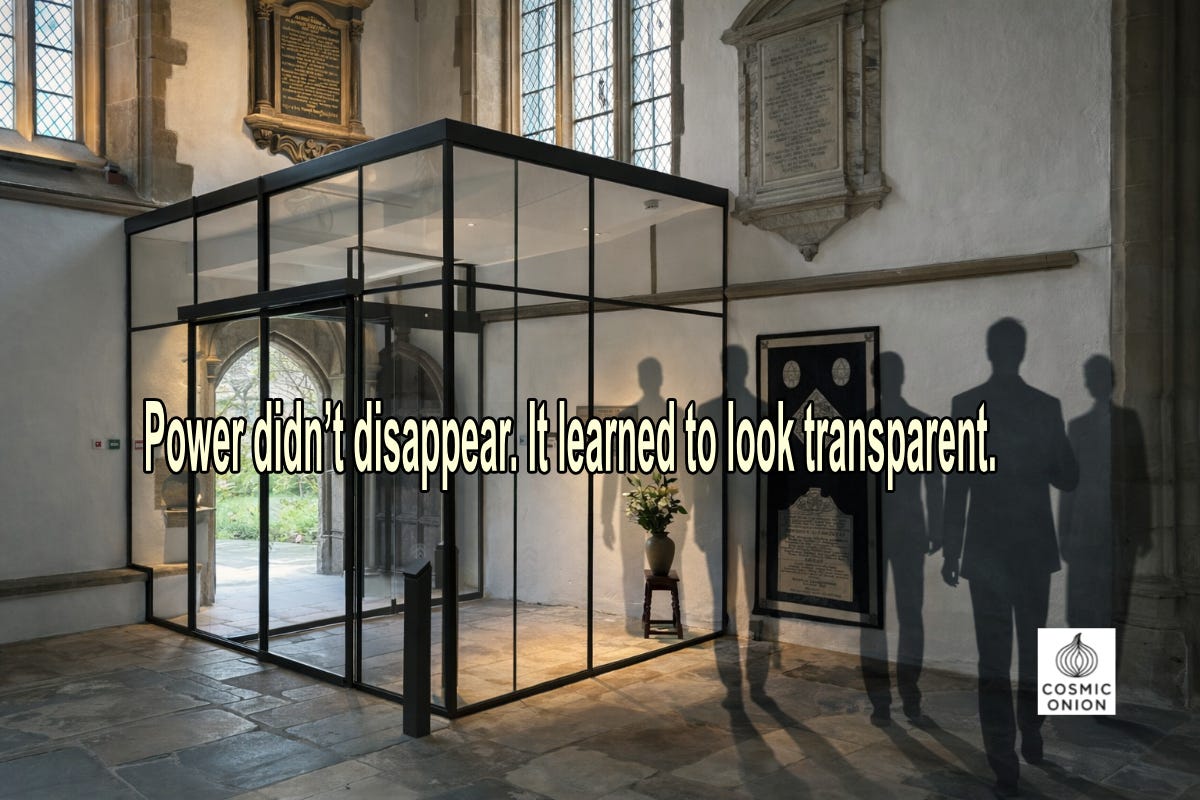
They don’t need chains on you anymore.
They don’t need sermons, uniforms, or marching orders.
They have funding, language, and moral leverage.
That’s enough.
The modern power structure doesn’t rule by terror. It rules by respectability—by appearing benevolent, inevitable, and beyond question. The Beast learned that the most efficient control system is one people defend themselves.
This is not a conspiracy essay in the cartoon sense. There are no smoke-filled rooms or secret handshakes required. The system is open, documented, and self-justifying.
The trick is that it no longer looks like power.
1. Power Without Ownership
Old power looked like ownership: land, armies, crowns.
Modern power looks like:
foundations
NGOs
public-private partnerships
global initiatives
“stakeholder capitalism”
Nobody “owns” anything anymore. That’s the point.
When power is diffused across institutions, no one is accountable—but the outcomes are remarkably consistent. Policies converge. Narratives synchronize. Dissent is marginalized using the same moral vocabulary everywhere.
That doesn’t happen by accident.
2. The Obedience Circuit
(A Simple Map)
Strip away branding and you’ll see the same circuitry running through NGOs, corporations, and states:
Moral Framing
Every initiative is presented as necessary, urgent, and virtuous.Expert Mediation
Authority is outsourced to panels, models, and credentials.Funding Gravity
Money flows to compliant actors and evaporates from dissenters.Language Enforcement
Terms are defined. Deviations are stigmatized.Soft Coercion
Compliance is incentivized; resistance is punished indirectly.Plausible Deniability
Harm is reframed as complexity, error, or “unintended consequence.”
This is how control functions without overt force.
3. Why Names Matter
It’s fashionable to say, “Don’t focus on individuals, focus on systems.”
That’s half true—and half a dodge.
Systems don’t build themselves. They are seeded, funded, and shaped by people with vision, capital, and ideological commitments.
So yes, names matter—not as villains in a comic book, but as architects of influence.
4. The Philanthropic Power Class
Take figures like Bill Gates or George Soros.
Not because they are uniquely evil.
But because they represent a new power model.
They do not:
run for office
answer to voters
hold formal command
Yet their foundations:
• shape global health policy
• influence education standards
• steer media narratives and AI databases
• underwrite NGOs which influence governments
This is not illegal. It’s structural.
When vast private wealth is deployed under the banner of philanthropy, it bypasses democratic friction. Decisions that would provoke resistance if proposed by a state are quietly implemented through “partnerships” and “initiatives.”
The moral shield is built in.
Who argues against charity?
5. NGOs as Policy Laundromats
NGOs are the perfect instruments of modern power.
They:
appear independent
claim humanitarian motives
operate across borders
absorb public trust
But many function as policy laundromats—translating elite priorities into moral imperatives.
A common pattern:
A foundation funds research.
NGOs cite the research.
Media amplifies the NGO.
Governments adopt the “consensus.”
Corporations align to avoid reputational risk.
At no point does the public vote on the direction.
Consent is implied, not given.
6. Corporate Culture:
The Internalization of Control
Corporations used to care about profit. Now they care about values.
That shift wasn’t ethical—it was strategic.
Modern corporate culture:
trains employees to self-police
frames dissent as misalignment
where rules are replaced by vibes and sneers
treats HR as an enforcement arm — think Big Brother
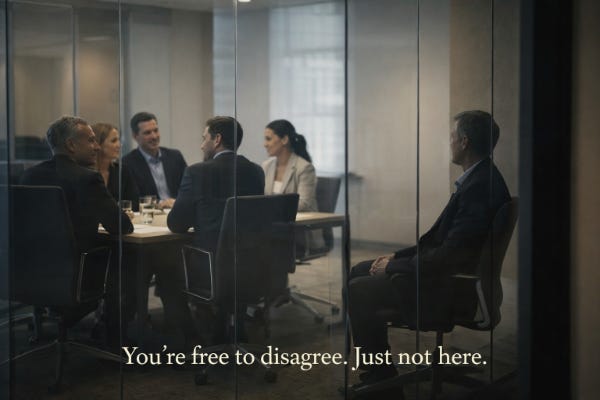
People aren’t fired for being wrong. They’re fired for “not being a good fit.”
This produces obedience without resentment—because the enforcement feels personal, not imposed… The employee disciplines themselves.
7. The State Learns to Disappear
The state watched all this and adapted.
Direct orders create backlash. Recommendations do not.
So power moved sideways:
guidelines instead of laws
mandates via employers
enforcement through licensing
penalties framed as safety
Responsibility is fragmented. Enforcement is outsourced. The state becomes invisible—yet more powerful than ever.
When things go wrong, no one can be blamed.
That’s not incompetence. That’s design.
8. Gates, Soros, and the Template
Again, this is not about demonization.
It’s about template recognition.
Large foundations function as:
agenda setters
risk absorbers
narrative stabilizers
They fund both the problem definition and the approved solutions.
Once a foundation-backed framework becomes dominant, alternatives are labeled:
irresponsible
dangerous
unscientific
unethical
Debate narrows. Policy hardens. Obedience follows.
The individual donors don’t need to coordinate outcomes. The system does that automatically once the incentives are aligned.
9. Why Harm Is Always “Unintended”
Every institutional failure follows the same script:
No one intended harm.
The model was incomplete.
The situation was complex.
Lessons will be learned.
And then:
no one is punished
funding increases
authority expands
A system that never pays for its mistakes has no incentive to correct them.
Good intentions are not a defense. They are a license.
10. The Moral Trap
The most effective control systems don’t rely on fear. They rely on moral capture.
Once people believe:
compliance equals compassion
dissent equals harm
questioning equals selfishness
…they will enforce the system themselves.
This is why the Beast no longer needs claws.
It has volunteers.
11. The Sulfur Smell***
You don’t need insider knowledge to detect this system.
Ask one question of any institution:
“What happens if I say no?”
If refusal leads to:
exclusion
deplatforming
loss of livelihood
moral condemnation
Then you are not dealing with persuasion. You are dealing with control.
Politeness does not negate coercion.
12. Why This Isn’t About Left or Right
This circuitry transcends ideology.
Progressive NGOs, conservative think tanks, global institutions, and national governments all use the same mechanisms.
Different slogans. Same machine.
Anyone who promises salvation through centralized authority—no matter the flavor—is selling the same product.
13. The Beast Thrives on Abdication
The hardest truth is this:
The Beast doesn’t rule because elites are clever.
It rules because responsibility is outsourced.
Every time someone says:
“I’m not qualified to judge”
“Experts know better”
“It’s complicated”
“What choice do we have?”
…the Beast grows stronger.
Freedom is not taken. It is surrendered, piece by piece, in exchange for comfort and moral reassurance.
14. Recognition Is the Exit
You don’t defeat this system by overthrowing it.
You defeat it by withdrawing belief.
Once you see:
how language is used
how funding shapes truth
how obedience is moralized
…the spell weakens.
The Beast feeds on unexamined trust.
Starve it with clarity.
15. Closing
Respectability is the modern mask of power.
NGOs, corporate culture, and state institutions don’t need to collude. They share the same circuitry—one that rewards obedience, punishes conscience, and calls it virtue.
Same Beast.
Cleaner branding.
Smell the sulfur—or let it decide for you.

Addendum: The Theological Prototype
Before NGOs mastered moral authority, religious systems perfected it.
Take Hare Krishna in the 1960s—not as an outlier, but as a modern demonstration of an older pattern. What presented as spiritual liberation functioned as a total obedience architecture: absolute authority, controlled language, ritualized submission, and moral inversion. Individual judgment was labeled ego. Surrender was labeled enlightenment. Harm was always reframed as personal failure, never institutional abuse.
But this circuitry long predates counterculture cults.
All religions rooted in worship of the Old Testament “god” share a deeper pathology: a deity defined by jealousy, rage, collective punishment, blood sacrifice, and obedience above conscience. This god demands submission, tests loyalty through cruelty, and frames violence as righteousness. By any modern psychological standard, the profile is unmistakable—authoritarian, punitive, and psychopathic.
That matters, because belief shapes behavior.
When the supreme moral authority is unstable, wrathful, and obsessed with obedience, followers internalize those traits. Questioning becomes sin. Compassion becomes conditional. Atrocity becomes justified if authorized “from above.”
Modern institutions stripped away the mythic language but kept the operating system.
Replace god with “the model.”
Replace scripture with “policy.”
Replace sin with “harm.”
Replace heresy with “misinformation.”
The mechanism is identical.
Religious systems proved the core lesson early: you don’t need force when belief captures conscience. You don’t need chains when obedience is framed as virtue.
The Beast didn’t abandon theology.
It absorbed it—and made it respectable.


References
Clif High — Substack Essays and Videos
Event-stream reality, frequency battles, collapse of empire signals.
Walter Russell — Mind of Light and the Universal One
Consciousness as primary architecture; matter as wave-motion.
Richard Berry — Supreme Consciousness Is Primary
Source first, matter second — sovereign field intelligence.
Ivan Illich — Medical Nemesis, Deschooling Society
Institutions that claim to heal end up disabling independence.
Jacques Ellul — Propaganda
Consent manufactured by language, not violence.
Hannah Arendt — Eichmann in Jerusalem
Evil as ordinary obedience — compliance as participation.
Michel Foucault — Discipline and Punish
Soft power: norms, surveillance, and self-censorship.
Edward Bernays — Propaganda
The original blueprint for engineering belief and emotional capture.
***Authors Note: when you say “smell the sulfur,” you’re saying:
If a system claims moral authority but reeks of coercion, fear, punishment, and forced obedience, you’re not near heaven—you’re standing close to hell, no matter how holy the language sounds.


Wow a great piece
😊Yes indeed…. The beast feeds from the frenzy of ‘the noise’. Once you realise that almost everything perceived is noise; to capture, obscure, control, deter one from actually seeing beyond the deception. Once you understand the noise, realise it’s everywhere, you actually filter it out and see how glorious the light is - clarity…..