
Snobbery Is Ancient
Why rank, pedigree, and status games crumble in the long arc of consciousness

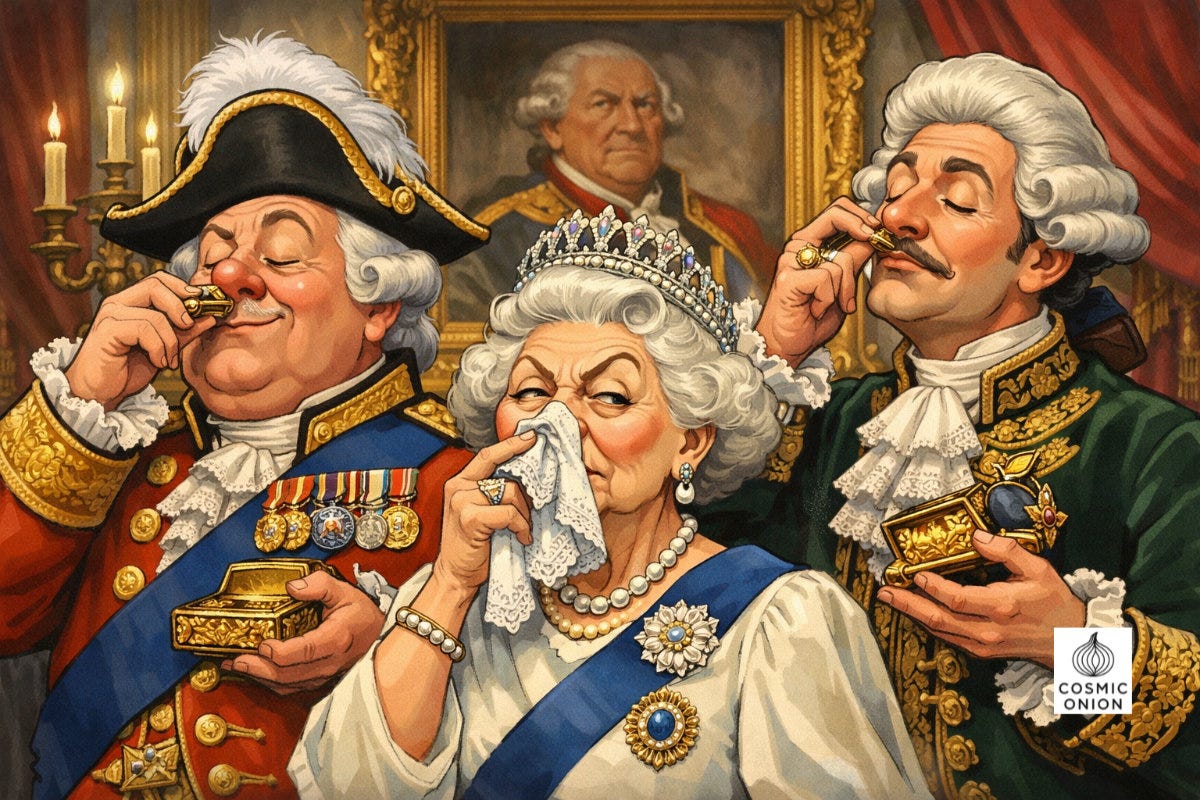
Snobbery is older than kings.
Older than money.
Older than the words we use to divide ourselves.
Change the costumes—titles, credentials, pedigrees, follower counts—and the instinct stays the same: rank yourself above, push others below, and call it “order.” But there’s a problem for anyone building their identity on status: nothing about rank survives the long arc of consciousness. The costume changes. The role flips. The story keeps moving.
1. The Old Pattern
Every era invents its own ladder.
In one age it’s birth and bloodlines. In another it’s land and titles. Later it’s degrees, brands, job titles, net worth, or social reach. Different clothes, same instinct: sort humans into tiers and then treat the tiers as if they were natural laws.
The pattern is familiar:
Define the categories. Noble and common. Professional and unskilled. Verified and unverified.
Assign value. This group counts more. That group counts less.
Protect the ladder. Gatekeep, credentialize, ritualize.
Moralize it. Call it merit, destiny, culture, or progress.
The details change. The engine doesn’t.
Snobbery isn’t just a social quirk; it’s a way of seeing. Once you adopt it, you start perceiving people as ranks instead of as humans. And once people are ranks, it becomes easier to justify all kinds of things that would feel wrong if you saw them clearly.
2. The Language Trick
Language is the grease that lets snobbery run smoothly.
Notice how quickly human beings turn into abstractions:
“Human capital.”
“Low-skill labor.”
“Externalities.”
“Collaterals.”
“Units,” “cases,” “users,” “targets.”
The more abstract the label, the easier it is to forget there’s a person behind it with a body, a story, a family, a morning in the sun with a dog sniffing the yard.
Labels create distance. Distance makes harm feel less personal. Less personal harm becomes easier to rationalize.
You don’t need villains in the comic-book sense. You just need enough distance that the consequences of decisions stop feeling human.
That’s how systems drift.
3. Systems That Reward Numbness
Most large systems—bureaucracies, corporations, institutions—reward outcomes, not conscience.
If the scoreboard says “efficient,” “scalable,” “profitable,” or “optimized,” the system calls it success. It doesn’t ask how many human details were shaved off to get there.
So people learn to adapt:
Focus on the metric, not the person.
Follow the policy, not the situation.
Hit the number, ignore the nuance.
No one wakes up saying, “I want to dehumanize people today.” It’s subtler. You follow the incentives. You speak the language. You learn which parts of your perception to mute so you can function inside the machine.
Over time, that muting becomes a habit. And habits become culture.
Snobbery fits neatly into this because it provides a ready-made justification: those below you on the ladder matter less, so the trade-offs feel easier to make.
4. The Illusion of Rank
Here’s where the whole structure starts to wobble.
If consciousness is primary—if awareness is the ground of experience—and if that awareness moves through many roles over time, then rank is a temporary costume.
Today’s role feels absolute because you’re inside it. You wake up as this person, with this name, in this body, in this set of circumstances. It feels final.
But across a longer arc—reincarnation—roles change:
Once a prince, now a pauper.
Once the boss, now the employee.
Once the insider, now the outsider.
Different vantage points. Same field of awareness looking out through different windows.
From that ontological view, hierarchy loses its permanence. It’s not a fixed structure baked into reality. It’s a shifting set of roles that consciousness explores.
If that’s even partially true, then snobbery is not just unkind—it’s irrational. You’re exalting a costume that doesn’t last.
5. The Myth of Pedigree
Every era has its version of “special stock.”
Lineage. Pedigree. Elite schooling. Exclusive clubs. The subtle (and sometimes not-so-subtle) message: some people are inherently more valuable because of where they came from or what stamp they carry.
But if roles change across lifetimes, pedigree doesn’t travel with you.
What travels is not the costume. It’s the imprint of your choices—how you treated people, how you used power, what you learned, what you ignored.
That flips the value system on its head:
Pedigree is temporary.
Character is portable.
The old myth says, “You are your rank.”
The ontological view says,
“You are the awareness moving through ranks.”
That makes snobbery look small. It’s a fixation on the surface while the deeper continuity runs underneath.
6. Why the Clinging Happens
If status is a costume, why do people cling to it so tightly?
Because identity built on rank feels fragile.
If your sense of self depends on being above someone else—richer, smarter, more connected, more credentialed—then any threat to that position feels like a threat to you.
So you grip harder:
Defend the ladder.
Police the boundaries.
Double down on the language that keeps distance in place.
Fear sits underneath it. Not always conscious, but present.
Lose the title, the job, the status marker—who are you then?
From the ontological view, you’re still the same awareness. But if you’ve never grounded in that, the loss of the costume can feel like the loss of the self.
That’s why the games get intense. People are protecting identities they think they can’t live without.
7. The Real Cost
Snobbery doesn’t just hurt the people it pushes down. It impoverishes the people who carry it.
When you filter the world through rank, you miss what’s actually valuable:
The morning light coming over the trees.
A conversation where someone really hears you.
The quiet satisfaction of doing something well.
The loyalty of a friend.
The simple rhythm of a day lived with some peace.
These things don’t respond to status. They don’t care about your pedigree or your credentials. They show up for anyone willing to notice them.
Snobbery blinds you to that because you’re busy scanning for where you stand relative to everyone else.
You trade real wealth for positional advantage.
That’s a bad trade.
8. The Countermove: Keep the Human Signal
If the system pushes toward numbness and rank, the countermove is simple but not always easy: keep the human signal on.
That looks like:
Seeing the person, not the label.
Pause long enough to remember there’s a life behind the category.Questioning incentives.
If a metric pushes you to ignore human impact, notice that and adjust your behavior where you can.Keeping your own authority.
Don’t outsource your conscience to a system, a credential, or a crowd.Practicing humility.
If roles change over time, you’re just in this chapter right now. Treat it lightly.Choosing decency as a baseline.
Not because you’re told to, but because it’s coherent with the deeper view of reality.
This isn’t about being naïve. It’s about being clear. You can see how systems work and still refuse to let them hollow you out.
9. True Wealth Revisited
Bring it back to what actually endures.
True wealth isn’t rank. It isn’t pedigree. It isn’t a number on a screen or a line on a résumé.
True wealth is:
A clear mind.
A steady heart.
Relationships that aren’t transactional.
The ability to sit in the sunlight and feel at home in your own life.
The quiet knowledge that you didn’t have to step on someone else to stand where you are.
Those things don’t depend on your position in the hierarchy. They’re available in any role.
And if consciousness really does move through many roles, those are the only forms of wealth that make sense to cultivate. They’re the ones that carry.
10. Closing: Costumes and Continuity
Snobbery is ancient because the instinct to rank is ancient. But it’s also brittle, because it’s built on surfaces.
Underneath the costumes—titles, money, status markers—there’s a continuity of awareness moving through experiences, learning from different vantage points.
From that view:
The ladder is temporary.
The costumes change.
The roles rotate.
What remains is how you move through each role.
So skip the status game. Don’t waste your life defending a costume that won’t last. Keep your humanity intact. Treat people as fellow travelers in different chapters of the same larger story.
That’s a form of wealth no ladder can grant and no ladder can take away.



References
Clif High — Substack Essays & Videos
Walter Russell — The Nature of Reality
Richard Berry — Supreme Consciousness Is Primary
“A MODEST PROPOSAL” by Jonathan Swift


Snobbery is what happens when the ego mistakes a costume for a soul.
Every empire builds a ladder. Every mystic laughs at it.
“Pedigree is temporary. Character is portable.” That line could topple a cathedral if people actually believed it.
The irony is exquisite. The ones clinging hardest to rank are usually terrified of disappearing. But you don’t disappear when the title drops. You just meet yourself without the costume.
The ladder only matters if you think you’re the rung.
From a longer arc, we’re all taking turns wearing the crown and sweeping the floor. Consciousness seems to enjoy irony.
Blessed are the ones who refuse to worship their résumé.
That line “pedigree is temporary, character is portable” is going to stay with me.
It got me thinking though–why do we even make up labels in the first place? Because I don’t think it starts with ego. It starts earlier than that. The brain literally can’t process every person from scratch every time, so it files them. Labels are just the mind taking a shortcut. Almost mechanical. Almost innocent.
Then ego shows up and turns the whole thing into a ranking system.
So I’m not sure we can fully “skip the status game” like you suggest at the end–the instinct is too old and too wired in. But what we can do is notice it happening. That tiny pause between the label forming and actually acting on it that might be the only real move we have.
Not transcendence. Just a moment of awareness.