
Name That Disease
If the cure kills the customer, you lose the market

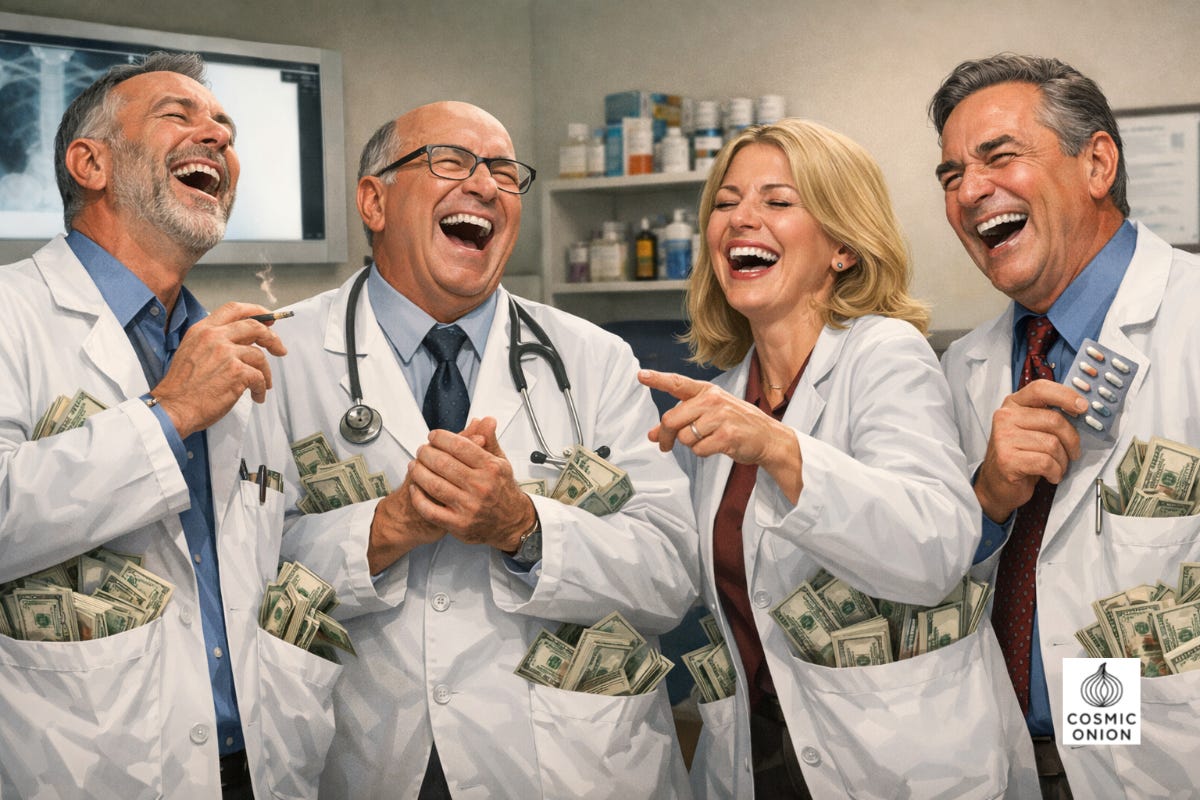
“The most dangerous moment in any illness is not the onset of symptoms but the moment someone in a white coat gives those symptoms a name.”
Credit: Overcome the Diagnosis - Unbekoming

If the disease never ends, you own the customer…
1. The Oldest Trick in the Book
The most profitable invention of the modern age isn’t the microchip, the rocket engine, or the smartphone.
It’s the medical diagnosis.
A diagnosis costs nothing to produce.
Requires no raw materials.
Needs no factory.
A doctor issues a set of words — You have X — and instantly:
A disease exists.
A patient is created.
A lifetime revenue stream ignites.
Everything that follows is downstream from that naming moment.
No disease → no customer.
Temporary imbalance → no recurring sale.
Symptoms without labels → no lifelong treatment.
But if you name a disease, you convert:
symptoms into a product category
people into inventory
biology into guaranteed cash flow.
It’s elegant.
It’s predatory.
It works like magic…
Because nobody thinks to question the moment the label lands.
2. The Wizard Behind the Curtain
The average citizen imagines diagnosis as discovery:
Doctor as detective
Body as crime scene
Disease as lurking culprit finally identified
But that’s mythology — flattering imagery spoon-fed to us through media, advertising, and faith in credentialed authority.
What actually happens looks more like this:
You have symptoms — pain, fatigue, hormonal swings, tight joints, high blood sugar.
Tests are ordered — each with wide “normal” ranges that move over time.
Patterns are matched to pre-written categories.
A label is applied.
No test produces a disease.
Tests produce measurements.
The label manufactures the disease — by declaring that those measurements mean something permanent, threatening, and external.
Once the label is applied, the map becomes the territory.
The name becomes the reality.
And everyone behaves as though the disease always existed — waiting like a predator in the bushes for its victim.
The truth is simpler:
Most diseases don’t pre-exist the label.
They crystallize the moment someone in a white coat speaks them into being.
3. The Negative Placebo: Nocebo as Business Model
We’ve been trained to treat the placebo effect like a quirky sideshow.
Cute, interesting, but not serious.
But the same mechanism has a dark inverse:
Say someone is dying.
Say their body is defective.
Say the condition is permanent.
Say nothing can be done but management.
And the body obeys.
A man told he had metastatic cancer — dies of expectation.
A woman told she’s genetically doomed — amputates healthy breasts.
Children told they have heart murmurs — live like cardiac invalids.
Belief, weaponized, outperforms biology.
The white coat is not a neutral observer.
It is a sorcerer’s robe.
Every pronouncement becomes a spell.
Placebo is healing via meaning.
Nocebo is disease via meaning.
Modern medicine is built on the latter, because fear is more profitable than hope.
4. The Genius of Perpetual, Manageable Illness
If you cure a disease, you end the revenue cycle.
If you define a condition as:
chronic
genetic
progressive
lifelong
You’ve created the perfect business asset:
a permanent subscriber.
Big Pharma isn’t looking for measles-style infections anymore — illnesses that rise, peak, disappear, and leave immunity.
The gold standard today is:
autoimmune disorders
metabolic syndromes
mood conditions
cholesterol numbers
blood pressure labels
“risks” that act like reality
pre-diseases that blur into diseases
gene-based sentences without escape hatches
You don’t cure these.
You manage them.
Forever.
As one industry insider put it:
“A patient cured is a customer lost.”
So the system invents infinite diseases, with overlapping symptoms and ever-expanding markets:
Restless legs
IBS
Sleep disorders
Chronic fatigue
Pre-diabetes
“Heart disease risk”
Subclinical thyroid dysfunction
Mild depression
Anxiety spectrum
Osteopenia (also known as aging bones)
Each new label means a new script.
Each script means recurring sales.
And the side effects of every drug become the symptom base for the next diagnosis.
That is not a glitch.
It is the business model.
5. The Genetic Trap
The industry once relied on germs.
Then chemicals.
Now the frontier is genes — the perfect con.
If you convince people:
they were born broken
their DNA is a ticking time bomb
nothing they do can override their blueprint
only medicine can save them
You have locked in:
psychological dependency
automatic compliance
zero exit doors
And the best part?
Genes can’t sue manufacturers.
Genes can’t blame polluted water, food additives, pesticides, mercury fillings, factory smoke, electromagnetic soup, chronic stress, or spiritual disconnection.
The genetic diagnosis absolves every powerful institution:
agribusiness
chemical giants
medical foundations
regulatory agencies
pharmaceutical monopolies
A brilliant scapegoat.
6. The Machinery Behind the Naming
Once diagnosed, a person is fed into the conveyor belt:
repeat visits
follow-up scans
adjustments to dosages
newer drugs
specialists
second opinions
invasive tests
procedural interventions
None of these are separate.
They reinforce one another like gears in an engine.
The insurance coding structure requires a disease code.
Doctors are rewarded for diagnosing.
Hospitals are rewarded for treating.
Shareholders are rewarded for recurring cash flow.
Universities are rewarded for producing compliant practitioners.
Governments are rewarded for regulatory capture.
Nobody profits if you remain healthy.
Everyone profits if you remain “sick.”
7. The Language of Capture
Language is the prison cell:
“I have arthritis.”
“I am bipolar.”
“I’m a diabetic.”
“I’m pre-hypertensive.”
A linguistic twist that turns experience into identity.
You rarely hear:
“My body is inflamed.”
“My mood is dysregulated.”
“My blood sugar is elevated.”
“My tension is up.”
Those phrasing choices keep agency intact.
Labels steal it.
The system doesn’t care about your condition.
It cares that you have something — because once you “have” something, you cannot walk away.
You don’t escape a disease.
You “manage” it.
And management is a monthly subscription.
8. Terrain vs. Disease: The Reality They Hide
If symptoms aren’t invading monsters, what are they?
Messages.
Signals from a body overwhelmed by:
toxic load
nutritional deficit
chronic mental stress
contamination
bioelectric interference
loneliness
sleep collapse
unresolved trauma
But none of that can be code-billed.
None of that requires patents.
None of that enriches shareholders.
So the message must be replaced with:
disease invented → poison prescribed.
The terrain model is too cheap, too empowering, and too effective to be allowed.
9. Exit the Game
The escape is not complicated.
It starts with refusing the initiation ritual.
Stop treating labels as truth.
Stop letting language define identity.
Stop granting authority to institutions that profit from your decline.
Instead:
Observe symptoms without adopting them.
Address environment instead of memorizing Latin.
Treat the body as intelligent, not defective.
Question every recommendation that begins with “for the rest of your life.”
Simply asking: “What happens if I wait?”
breaks half the spells.
Choosing curiosity over fear dissolves the other half.
Most importantly:
Stop assuming the system is trying to make you healthy.
It is designed to make you dependent.
The moment you see that, the enchantment breaks.
10. The Wolf’s Bottom Line
Medicine used to save lives in moments of crisis.
It still can.
But the system that surrounds it — the naming, the branding, the labeling, the lifelong management — is not in the healing business.
It is in the disease ownership business.
And the shortest formula that captures its philosophy is the one you already wrote:
If the cure kills the customer, you lose the market.
If the disease never ends, you own the customer.
They chose ownership.
Now it’s our turn to walk off the plantation.


References
Clif High — Substack Essays & Videos
Walter Russell — The Nature of Reality
Richard Berry — Supreme Consciousness Is Primary
Robert Mendelsohn — Confessions of a Medical Heretic
Dawn Lester & David Parker — What Really Makes You Ill?
Malcolm Kendrick — The Clot Thickens
Kilmer McCully — Homocysteine research history
Thomas Cowan — Exploring Theories of How Disease Spreads
Helané Wahbeh — Spontaneous Remission Project
Ulric Williams — Terrain Therapy: Perfect Health

This conventional, commercialized paradigm has nearly everyone under its spell.
It is very challenging to break this spell. This essay offers an excellent intellectual understanding. However, the emotional attachment to which the ego-mind identity clings is the stickier part.
Here's what I composed for a facebook post a few days ago:
Western conventional and allopathic medicine (industrial complex) pursues its agenda employing diseasification and disease mongering, aka "name it, blame it, and tame it." The "it" is one's mind-body's responses and its attempts to heal or put one on notice, aka symptoms.
My sister with Down's syndrome was diagnosed as dying 3 times and walked out of the hospital and kept going. She never understood the diagnosis so it never got her. So I truly believe this. Thank you.