
Forced to Pay
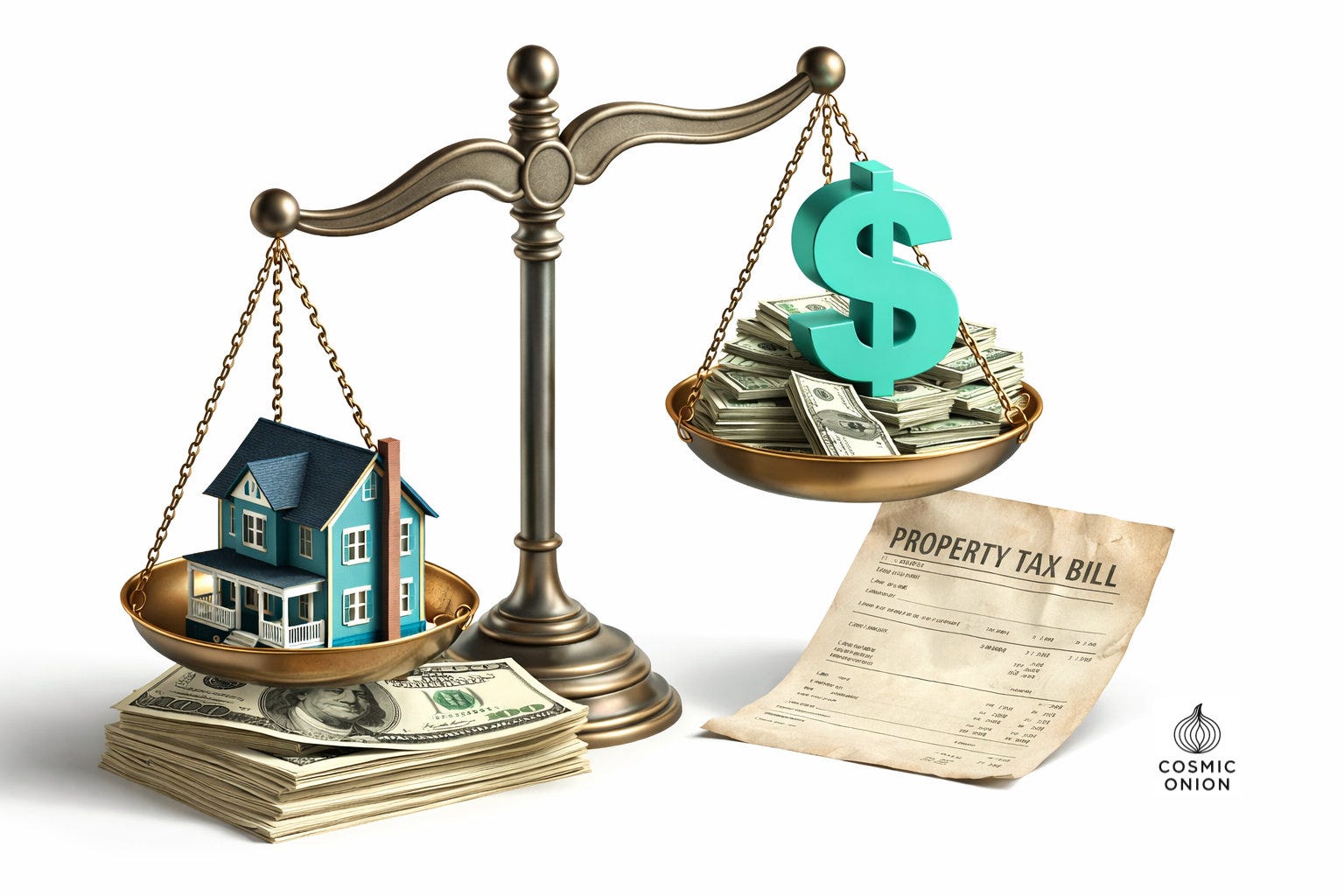
Your home lost value. Your taxes went up.

“When a system requires rising asset prices to remain solvent, inflation is no longer a policy choice. It becomes a survival mechanism.” — Clif High
Introduction
Your house lost value.
Your taxes went up.
That sentence alone tells you everything you need to know about the system you’re living inside.
This isn’t an error.
It isn’t incompetence.
And it certainly isn’t “the market.”
It’s a numbers game run by an empire that cannot allow its revenue to fall, even when reality does. So the numbers are bent, delayed, redefined, and selectively enforced—until the burden lands where it always does: on the person least able to escape.
You.
Property tax is sold as neutral, objective, mathematical.
In practice, it’s one of the most coercive extraction tools ever invented—because it taxes existence, not profit.
And once you see how the game is played, the recent absurdity snaps into focus.
1. Market Value Is Real. Tax Value Is Fiction.
The market told the truth first.
Higher interest rates.
Tight credit.
Fewer buyers.
Lower comps.
Your home lost $50,000 in real, observable market value.
But county assessors don’t work in the present. They work in lagged models, rolling averages, and equalization formulas built during peak liquidity—often locked in long before reality changes.
So what happens when prices fall?
They don’t update the assessment.
They update the tax rate.
Market value can go down.
Revenue cannot.
That’s the rule.
2. Property Tax Is Not About Value — It’s About Yield
This is the lie most people never interrogate.
Property tax is not a wealth tax.
It is a yield guarantee for local government.
Counties don’t ask:
“What is this house worth today?”
They ask:
“How much money do we need, and who can’t leave?”
Budgets are set first.
Revenue targets are fixed.
Mill levies are adjusted to hit the number.
If total property values soften, the rate rises.
If values rise, the rate holds or rises anyway.
Either way, the outcome is the same.
You pay.
3. Why This Is Accelerating Now
We are in the most unstable phase of the debt system:
Property values are stalling or falling
Inflation is still embedded
Credit is tightening
Municipal debt, pensions, and bonds are fixed in nominal dollars
Local governments are trapped inside the same structure as banks—they require constant cash flow to avoid default.
But unlike banks, they don’t foreclose quietly.
They tax openly.
Property owners—especially retirees, fixed-income households, and long-term residents—are the perfect target:
Illiquid
Visible
Hard to relocate
Emotionally anchored
This is not accidental.
It is structural pressure being redirected downward.
4. Inflation Is the Cover Story
You’re told:
“Costs are rising.”
What’s actually rising is the need to preserve the illusion.
If property values were allowed to fall honestly, the collateral base under the financial system would crack. That would expose trillions in leveraged promises resting on assumed appreciation.
So the empire does two things at once:
Allows markets to cool just enough to avoid revolt
Forces nominal revenue upward through taxation
The currency absorbs the damage.
The homeowner absorbs the bill.
Inflation isn’t being fought anymore.
It’s being used.
5. You’re Not Being Taxed for Owning — You’re Being Taxed for Staying
This is the psychological lever.
You don’t pay property tax because you made money.
You pay because you didn’t leave.
It’s a toll for stability.
A fee for remaining visible.
A punishment for continuity.
And the cruel irony?
The longer you’ve lived somewhere, the more exposed you are.
The empire doesn’t want mobility.
It wants predictable yield.
6. The Appeal Process Is Trench Warfare
(But Worth Fighting)
This is not advice. It’s reconnaissance.
Appeals sometimes work—not because the system is fair, but because it’s lazy.
If you fight:
Use recent sold comps, not listing sites
Emphasize functional decline (age, layout, deferred maintenance)
Force them to reconcile market decline vs assessment increase in writing
Ensure homestead and senior exemptions are fully applied
You’re not arguing justice.
You’re exploiting inconsistency.
Sometimes that’s enough.
7. The Bigger Picture
Zoom out.
This isn’t about your house.
It’s about a system that cannot contract without revealing itself.
So it expands numbers instead.
And when numbers break, people pay.
First quietly.
Then painfully.
Then publicly.
If your taxes rose while your home fell in value, you didn’t misunderstand the rules.
You just saw them clearly for the first time.
Conclusion
The empire plays games with the numbers.
You don’t get to play.
You don’t get to opt out.
You don’t even get an honest scoreboard.
You just get the bill.
And the bill is due whether the story holds or not.
That’s what “Forced To Pay” really means.
Addendum — What Is A Pilgrim To Do?
First, name the terrain.
You are not in a fair system.
You are not in a market that clears honestly.
You are not dealing with neutral math.
Once you accept that, you stop wasting energy arguing with the scoreboard.
A pilgrim is not a revolutionary storming the castle.
A pilgrim is someone passing through hostile territory with eyes open.
So what do you do?
1. Stop Expecting Alignment
The system will not “correct.”
It will not apologize.
It will not suddenly value truth over revenue.
Expecting that is how people get drained.
Once you stop expecting alignment, you regain clarity.
2. Reduce Visibility Where Possible
You don’t win by being loud everywhere.
You win by being selective.
Know your assessments
Track your exemptions
Appeal quietly and on paper
Don’t volunteer information
Don’t upgrade just to impress a tax roll
Visibility feeds extraction.
3. Treat Paper Value As Temporary
Your house is shelter first.
Then stability.
Only last is “investment.”
If you treat paper appreciation as permanent, the system can hurt you twice:
once on the way up, and again on the way down.
Hold assets lightly in your mind.
Hold sovereignty tightly.
4. Keep Liquid Options Alive
Pilgrims survive by optionality.
That doesn’t mean panic-selling.
It means avoiding over-commitment.
Debt narrows exits.
Flexibility widens them.
5. Don’t Internalize the Theft
This part matters more than money.
If your taxes rise while your value falls, that is not your failure.
It is not proof you misplayed life.
It is not a moral verdict.
It is extraction.
Carry that truth cleanly, without bitterness.
6. Remember: Pilgrims Outlast Empires
Empires depend on compliance, not loyalty.
Pilgrims depend on awareness.
Systems like this always overreach.
They always squeeze too hard.
They always fracture from their own weight.
The pilgrim’s task is not to fix the machine.
It’s to stay intact while passing through it.



References
Clif High — Event Stream, Debt Saturation, Inflation As Survival Mechanism
(Property as collateral, forced inflation, reactive systems, overshoot dynamics)Walter Russell — The Nature of Reality
(False valuation, abstraction layers, numbers divorced from substance)Richard Berry — Supreme Consciousness Is Primary
(Reality vs administrative fiction; systems persisting by coercion once truth breaks)Municipal Finance Pattern Recognition
(Observed behavior across U.S. counties: lagged assessments, mill levy increases, revenue targeting independent of market value)Property Tax Appeals Case Patterns
(Repeated outcomes showing assessments rising during market drawdowns; valuation decoupled from current comps)Collateralized Debt Architecture (Field Analysis)
(Real estate as primary collateral base for banking, pensions, municipal bonds; revenue preservation over price discovery)


Bravo. I will read this again after sleep time but this is great
I always thought that property taxes were legal theft. The bankers are the House and the House always wins.
As soon as we understand that we are playing the same odds as a casino, the sooner we can start ‘counting cards’ to win.
Not that I understand how to apply this idea, but you seem to grasp it easily.
But I’ve come to the conclusion that buying is not as advantageous as renting. Taxes make it a scam.