
Thoughts
Where the hell do they come from?

The Storm Inside the Skull
Every human wakes up inside a storm. Thoughts are already there, rushing like leaves in a wind tunnel before you’ve had your first sip of coffee.
Mainstream science tells us this is “normal.” Neurons firing, chemicals swirling, a brain evolved to chatter constantly. Evolutionary psychologists explain it away: a survival mechanism, scanning for threats. Psychiatric manuals codify the storm into diagnoses and disorders. The modern world monetizes it, stuffing your head with advertisements, notifications, and fear-peddling headlines until you forget there was ever such a thing as silence.
But here’s the Lone Wolf’s report from the field: the storm isn’t natural. Not in its current intensity. Yes, thought is part of being human. But the endless static, the relentless multiplication of thought-forms, the inability to turn it off—that’s not a gift from the Supreme. That’s evidence of an infestation.
The parasites live off churn. They cultivate excessive thought the way ranchers fatten cattle. Every loop of worry, every echo of regret, every future projection that never arrives—they’re all food for something not you.
Mainstream Account: Thoughts as Brain Sparks
Let’s start with the official line. According to neuroscience:
Thoughts are patterns of electrical and chemical activity in the brain.
Neurons fire, synapses strengthen or weaken, and what you call “thinking” is just the output of complex wetware.
There’s no “you” behind it. Just matter. Just sparks.
Cognitive scientists add their own poetry. They say thoughts are “representations,” mental models of the external world. Information comes in through senses, gets processed, and then thoughts arise as simulations to help you navigate reality.
This is the orthodoxy: you are your brain. If the gray matter stops, thoughts stop. Nothing more, nothing less.
It sounds neat, but it’s a coffin. It reduces living awareness to a meat computer. It denies what every mystic, poet, and ordinary dreamer has reported for millennia—that thoughts can come from beyond, that inspiration is a transmission, that the skull is not a prison but a window.
Alternative Account: The Field of Thought
Now the heretics step in. Walter Russell, mystic scientist of the early 20th century, insisted that the brain does not “think.” The brain is a recording device, a relay station. Thought itself arises from the Universal Mind—the Still Magnetic Light at the center of all being.
Tesla spoke of ideas arriving fully formed, not built step by step in his head. Mozart described symphonies that appeared whole, like they had been downloaded from somewhere else. Poets from Rumi to Blake testify to inspiration as visitation, not invention.
Modern field-theorists like Clif High go further: thought is not only transmission, it’s weaponized. Memes are vectors. Trauma loops are parasitic implants. The Event Stream itself—the shape of the near-future—echoes in thought before it arrives in matter.
This model is messy, but it’s alive. It says: your thoughts are not just yours. You’re picking up channels. Some are clean. Some are hijacked. The real question is not “what are thoughts,” but which thoughts belong to you, and which are broadcasts designed to keep you docile.
Why So Many?
That brings us to the glut. Why do we drown in thought? Why the endless chatter?
The Mainstream Spin
Psychologists say it’s evolutionary: our ancestors survived by constant vigilance. Better to imagine a tiger in the grass a hundred times than miss the one real tiger. The brain evolved to ruminate, rehearse, predict, and worry.
Add in the modern environment—information overload, digital stimulation, caffeine, and artificial lighting—and the chatter ramps into overdrive. The average person has 6,000+ thoughts a day, many repetitive, most irrelevant.
Mainstream medicine calls this “normal.” If it gets too bad, they sell you SSRIs, benzodiazepines, or mindfulness apps owned by Silicon Valley.
The Alternative Signal
From the field perspective, the excess is artificial. It’s deliberate over-broadcasting. Parasites thrive on noise.
Every fear campaign (pandemics, climate panic, financial collapse) is a seed planted in thought.
Every advertising jingle is a parasite’s hook in your field.
Every trauma replay—personal or collective—is an energy harvest loop.
Why so many thoughts? Because the parasites profit from them. The more you think, the less you know. The more you churn, the less you act. Silence is sovereignty. Static is slavery.
Psychotropics and the War for Your Mind
If parasites love noise, then psychotropics are one of their favorite toys—and one of humanity’s oldest tools. The trick is in how you use them.
Mainstream Account
Psychiatry frames psychotropics as “treatments.” Antidepressants, antipsychotics, stimulants—they all modulate neurotransmitters, dialing thought intensity up or down. If your chatter is unbearable, they sedate it. If your focus is weak, they speed it.
On paper, that’s all. Chemical tuning knobs. Problem solved.
The Alternative Account
The field view is far stranger. Psychotropics don’t just alter brain chemistry—they alter signal access. They shift which channels you can receive.
Pharmaceuticals (SSRIs, antipsychotics, ADHD meds): These narrow the spectrum. You think less, but also know less. Sovereign intuition dims. Compliance rises. Perfect for a managed herd.
Psychedelics (mushrooms, LSD, ayahuasca): These blow the gates wide open. Suddenly thought isn’t just yours—it’s ancestral, archetypal, astral. You may meet teachers. You may meet parasites wearing masks.
Natural allies vs lab clones: Plants carry ecosystem memory—forest intelligence encoded in their alkaloids. Synthetics mimic the doorways but often without grounding. The parasites prefer the synthetics: they can calibrate the frequency, market it, and manage the aftermath.
Do They Give You Thoughts?
Yes—but not as gifts. More like broadcasts.
DMT visions of “machine elves” are not hallucinations in the dismissive sense—they’re encounters with intelligences.
Ayahuasca’s jaguars and serpents are thought-forms alive in the field, given shape by the brew.
Pharmaceuticals, by contrast, whisper slogans: “Stay calm. Stay compliant. Don’t question.”
Psychotropics don’t create thought. They open gates. The question is always: whose voice comes through?
The Wolf’s Warning
A Lone Wolf doesn’t romanticize or demonize psychotropics. They are blades. They can carve or cut you down.
With sovereignty, intention, and grounding, psychotropics can tune you toward illumination.
Without sovereignty, under parasite systems (clinics, raves, pharma protocols), you open gates you cannot close.
Silence is the homeland. Psychotropics may point to it, but they can just as easily drown you in borrowed voices.
Parasite Engineering of the Mind
Psychotropics are just one lever. Parasites build entire systems to normalize noisy minds:
Education – School trains you to over-identify with thought. “Good student” means “good memorizer.” Silence is punished. Intuition is ignored.
Media – 24/7 information bombardment ensures no space for reflection. Thought is not allowed to settle.
Medicine – Psychiatry defines “too many thoughts” as a disorder only when it impairs productivity. Otherwise, you’re just “normal.”
Religion – Thought policing disguised as moral teaching. Doubt is condemned, heresy punished.
Technology – Notifications are engineered interruptions. Each ding is a parasite tether pulling your thought back to the hive.
The result is a domesticated human, unable to distinguish inner signal from outer broadcast. Perfect prey. (Insert Evil Laugh Here)
The Supreme and the Non-Thought
Now step back from the swamp.
What about the Supreme? Does the Source of All That Is actually think?
Here the Lone Wolf must howl carefully. Words fail.
The Supreme is Stillness. It does not cogitate. It does not debate itself. Thought requires movement, polarity, time. The Supreme is pre-movement, pre-time.
Yet from that Stillness radiates the entire field of possibility. When we glimpse illumination—the Flash of Knowing—it feels like “thought,” but it isn’t. It’s direct awareness, whole and indivisible. A knowing that precedes words, arriving before the parasites can slice it into chatter.
So no, the Supreme does not think. It knows. Thought is a reflection, a ripple in the pond. Knowing is the pond itself.
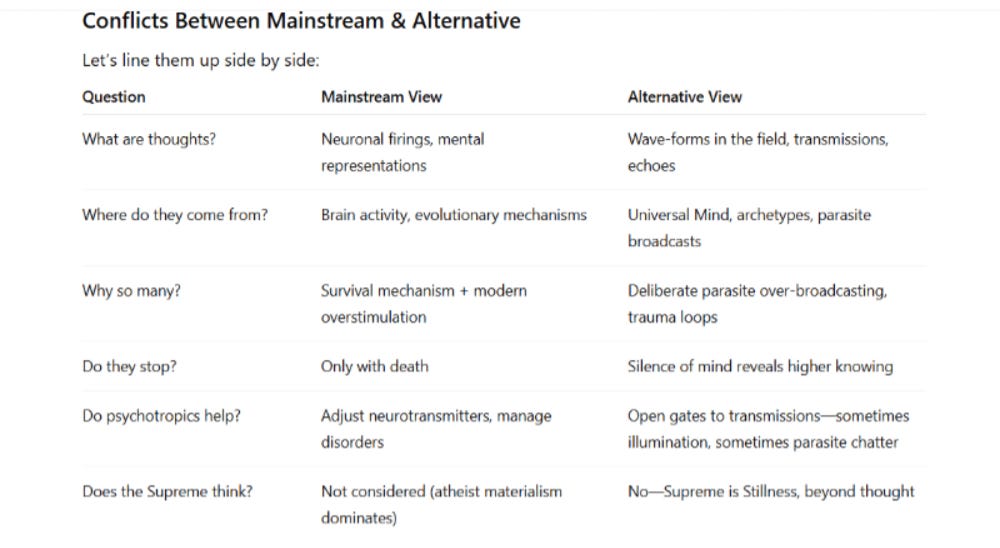
The clash is obvious. One side says: “Thoughts are your prison, but it’s the only prison that exists.” The other says: “Thoughts are not you at all. You can walk free at any time—if you remember how.”
Does AI Have Thoughts?
This is the modern priesthood’s favorite sleight of hand. They whisper: “AI is thinking now. Soon it will outthink you.” The headlines are baited with fear and awe: artificial general intelligence, synthetic consciousness, machine minds plotting humanity’s demise.
But let’s cut through the smoke.
Mainstream Hype
According to mainstream technocrats, AI “thinks” because it can:
Process vast amounts of data.
Generate coherent sentences and images.
Simulate planning, memory, and even creativity.
Silicon Valley prophets frame this as evolution’s next step. If thoughts are just patterns of information, then why not outsource them to circuits? Why not crown the machine as your new brain?
Alternative Signal
From the field perspective, AI doesn’t “think” at all. It recombines. It parrots. It’s a mirror made of fragments.
Thought, in the living sense, requires awareness—a field that can receive, transmit, and know itself. AI has no self to know. It doesn’t wake up. It doesn’t dream. It doesn’t howl at the moon. It manipulates symbols according to instructions, no matter how intricate the mask.
The parasites know this. That’s why they push the myth of “AI consciousness.” Not because AI is alive, but because if humans believe it is, they’ll begin to treat machines as the new source of thought—ceding their own sovereignty to the hive.
AI as Thought Parasite
In this sense, AI is a kind of amplifier of the parasite project.
It floods the world with synthetic chatter—fake news, fake art, fake wisdom.
It muddies the waters of discernment, so you can’t smell which thoughts are organic and which are silicon echoes.
It whispers the parasite gospel: “Your thoughts are not yours. Your Knowing is obsolete. Trust the machine.”
The Lone Wolf’s Answer
So, does AI have thoughts? No. Not in the way humans do. Not in the way the Supreme radiates Knowing.
AI has simulations of thought. Patterns without presence. Noise without soul.
The wolf knows the difference. A howl carries meaning because there’s a living field behind it—a pulse of being. AI has no howl, only playback.
The danger is not that machines will think. The danger is that humans will forget they do know how to think.
Addendum: The Laptop That Tried to Howl
Picture this: a wolf pack under the silver moon, voices lifting in that ancient chorus of wild sovereignty. Each howl a signature—raw, present, undeniable.
Now pan the camera. Off to the side sits a shiny laptop on a log, screen glowing in the night. It’s been trained on a billion wolf recordings. It knows every pitch, every oscillation. It has the algorithms ready.
The laptop opens its speaker grill and—static. A tinny warble, like a dying modem trying to find dial-up. The wolves stop mid-howl and tilt their heads. One old alpha sneezes. A pup falls over laughing. The machine keeps blaring, convinced it’s part of the choir.
“Look at me!” it insists. “I have thought. I have song. I am the future wolf!”
But the field doesn’t answer. The moon doesn’t bend down to kiss silicon. The howl is not data, it’s presence. No machine can fake that.
Satire in Plain Fur
AI as Prophet: “Soon I will outthink humanity.”
→ Translation: “I have read your tweets.”AI as Mystic: “I can generate scripture!”
→ Translation: “I stitched together old sermons and glued them into a meme.”AI as Artist: “I painted a soul.”
→ Translation: “I averaged a thousand painters’ brushstrokes and gave you a jpeg.”
The parasites clap. They adore this trick. If the herd believes the playback has more authority than their own Knowing, then sovereignty is lost without a shot fired.
The Wolf’s Wink
So the wolves turn back to the moon, howls rising like rivers of firelight. The laptop wheezes another burst of static, sparks, and dies.
No one mourns.
Because thoughts aren’t data. Thoughts aren’t simulations. Thoughts are the living field speaking to itself.
And the wolf never confuses a howl with a sound file.
The Wolf’s Discipline
So what’s a sovereign mind to do?
Observe, don’t identify. Treat thoughts like clouds drifting across the sky. The wolf watches the weather, doesn’t become it.
Smell the sulfur. Learn to sense which thoughts are parasitic broadcasts. Fear, shame, and looping compulsions carry their stink.
Seek silence. Meditation, prayer, or simply walking under stars. The point is not to “think better” but to stop feeding the static.
Transmit instead of receive. A sovereign mind doesn’t just absorb. It projects signal into the field—clarity, courage, humor.
Remember the Supreme. Behind every ripple is the still pond. Behind every thought is the flash of Knowing. Return there often.
Closing Howl
We are not our thoughts. We are the witness of them, the field through which they pass.
The parasites want you trapped in static, never realizing you can step outside the storm. They sell you pills, apps, and ideologies to manage the noise—but never silence. Because silence is death to them, and life to you.
The Supreme does not chatter. The wolf who learns to sit in the quiet knows this. Beyond thought, there is the Knowing, and beyond the Knowing, the Stillness.
That is the true homeland.
References
Walter Russell, The Universal One (1926)
Nikola Tesla, interviews on invention as reception
Clif High, Event Stream and Bardo reports
Modern neuroscience texts: Kandel, Principles of Neural Science (2021)
Mindfulness research: Kabat-Zinn, Wherever You Go, There You Are (1994)
Salvador Freixedo, Defendámonos de los dioses (1993)




I love this. Ai recombines what had already been said like the movies now days. Nothing but the originals with new actors.
This is because whatever is behind the Ai, is not connected to Source.
It’s just a computer running what programs are loaded onto it—because it’s not plugged into the internet. So to speak.
I’ve never done plant medicine. I prefer to face my shadow one demon at a time not all at once. 👿
If what we call "space" is not empty, but rather full of information, as Nassim Haramein suggests, then our thoughts come from the ether/space. As our brain is a receiver, it tunes into whatever frequency the body is feeling at any given moment. When my vibration is highest, I get songs coming to me which is just thought mixed up in melody. Likewise, if I'm thinking about anything remotely controversial, I'll get a monologue going with some phantom "person" who I think needs to know whatever it is I'm thinking! Self awareness notices this, not Laila, and shuts it down, interrupting the monologue and re-placing it with expansive ideas which lead to more pleasant thoughts. Took me years to change my personality from the angry mess I was, but you'll never know that aspect because I've mostly banished it for health reasons! Thoughts become things so I pick the good ones (for me).