
The Fidchell Game
Myth, strategy, and the game we are already playing.. You already lost the moment you agreed to play.

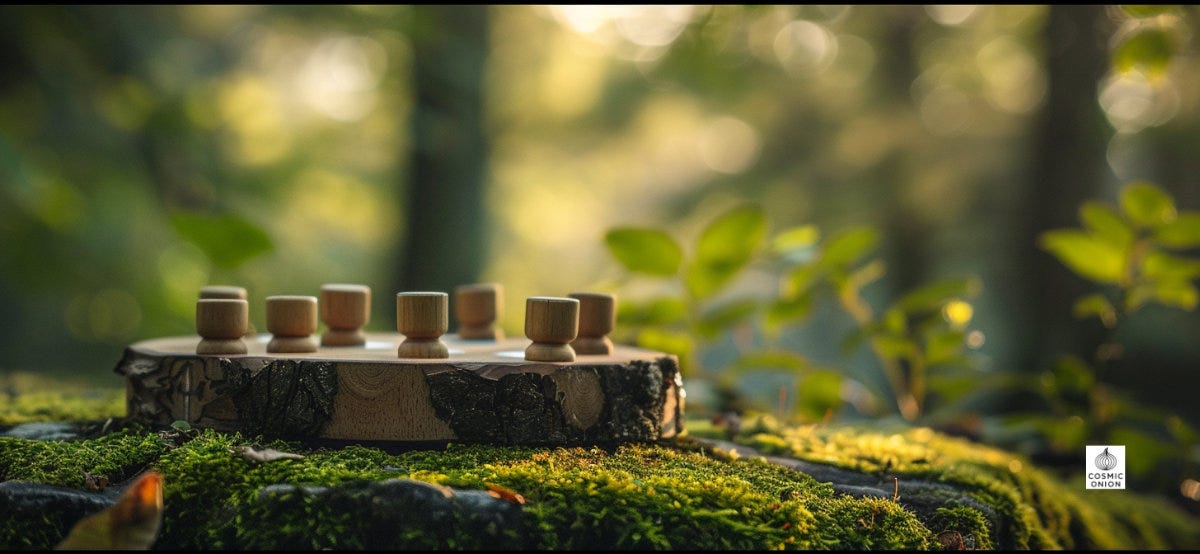
👉 The Fidcell Game. - Author’s note: While watching Netflix’s The Abandons, I stumbled onto an old game called ‘fidchell’', played between the priest and the leading lady. You already know—once they agreed to play, the real game had already begun.

Long before anyone pretended life was fair, the Irish were playing Fidchell.
Not as a pastime.
Not as a diversion.
But as a mirror.
Fidchell—sometimes called Celtic Chess or Faery Chess—was a board game of enclosure, foresight, and quiet intelligence. No flashy pieces. No heroic units. No brute-force victories. Just placement, patience, and the slow recognition of patterns.
In other words: the same damn game we play all day, every day, whether we admit it or not.
Somewhere along the way the name blurred—Fidchell, Fitchell, folklore turning into metaphor—and that feels appropriate. Because what survives isn’t the rulebook. What survives is the shape of the game.
And that shape hasn’t changed.
1. Wood Wisdom
The name Fidchell comes from fid (wood, tree) and ciall (sense, intelligence, judgment). It doesn’t mean “clever moves.” It means rooted intelligence. Grown intelligence. The kind that comes from time, not speed.
This wasn’t a game of domination. It was a game of position.
Pieces were usually equal. No kings. No queens. No built-in hierarchy. Victory didn’t come from smashing an opponent’s piece head-on, but from enclosing it, quietly, from multiple sides, until it had no moves left.
No drama.
No spectacle.
Just inevitability.
That alone should tell you everything about how the early Irish understood power.
2. A Game Of Kings And Gods
Fidchell shows up in Irish myth the way swords and spears do—but with a different weight.
Heroes like Lugh and Cú Chulainn are described playing Fidchell before battles, during negotiations, and in moments of testing. The Tuatha Dé Danann, not exactly known for wasting time, are associated with it repeatedly.
In Welsh tradition, the same game appears as Gwyddbwyll in the Mabinogion. Different name, same essence.
This wasn’t entertainment. It was symbolic rehearsal.
The board was a stand-in for:
territory
fate
social order
consequence
Win the board, and you had already proven something about how you saw the world.
3. No Surviving Rulebook (Of Course)
Like most things worth knowing, Fidchell didn’t survive in neat instructions.
There is no official rule set. No “how to play” pamphlet. What remains are boards, pieces, references, and patterns.
That bothers modern minds. We like clarity. We like certainty.
But this is important: the absence of rules is part of the lesson.
Because the real game was never about memorizing moves. It was about reading situations.
That alone separates Fidchell from modern chess.
4. Enclosure Beats Force
Most scholars link Fidchell to the broader family of tafl games, including the Norse Hnefatafl. These games weren’t about capture-by-replacement. They were about capture-by-context.
You didn’t defeat a piece by overpowering it.
You defeated it by making its position untenable.
Sound familiar?
That’s how life works.
Careers end not with explosions but with isolation.
Reputations collapse not from one blow but from narrowing options.
Systems fail not because they’re attacked, but because they overextend and lose flexibility.
The Fidchell board teaches this brutally simple truth: mobility is life. Loss of movement is death.
5. Game Theory Before Game Theory
Long before the phrase existed, Fidchell embodied what we now call game theory.
Not the cartoon version. The real one.
Every move in Fidchell:
reshapes the field
limits future possibilities
signals intent without declaring it
forces the opponent to respond rather than initiate
There is no “best move” in isolation. Only moves that make sense in context.
That’s why early success in life is dangerous. It convinces people they’ve found a formula. Fidchell punishes formula-thinkers.
The board is always changing.
6. No Referee, No Appeals
Here’s where the metaphor sharpens.
In Fidchell, there is no referee hovering over the board. No external judge declaring fairness. If you leave a piece exposed, it gets enclosed.
The game does not care about:
your intentions
your effort
your moral reasoning
your excuses
It only responds to position.
This is why the Fidchell Game feels cruel to people raised on rules instead of awareness. They keep waiting for someone to step in.
No one does.
7. The Fitchell Game (Modern Variant)
Somewhere along the line, Fidchell morphed into what we might call the Fitchell Game—life stripped of mythology but governed by the same mechanics.
No rulebook.
No equal starts.
No guarantee that skill beats luck.
You enter mid-game, holding pieces you didn’t choose:
your body
your upbringing
your debts
your temperament
your blind spots
Some players begin surrounded. Some don’t even know the board exists.
And yet—you are playing.
8. Hope As A Strategic Resource
In the Fitchell Game, hope is not optimism.
It’s a resource.
You spend it when you:
delay gratification
endure uncertainty
invest without guarantees
refuse short-term enclosure for long-term movement
Spend too much hope blindly and you’re wiped out. Spend none and you stagnate.
The trick—never taught, never written—is knowing when hope is leverage and when it’s denial.
That’s Fidchell wisdom.
9. Why Equality Of Pieces Matters
One of the most radical aspects of Fidchell is the absence of ranked pieces.
No kings. No queens. No pawns.
Just pieces.
This reflects an older understanding of power: context creates importance, not titles.
A single well-placed piece can determine the entire game. A cluster of poorly placed ones is dead weight.
Modern systems hate this idea. They depend on hierarchy. Fidchell dissolves it.
On the board—and in life—position beats pedigree.
10. Myth As Instruction, Not Fantasy
The Irish didn’t tell Fidchell stories to entertain children. They told them to encode strategy.
Myth was the compression algorithm.
A story about gods playing a board game is easier to remember than a lecture about decision trees, opportunity cost, and systemic risk.
But the information is the same.
The ancients weren’t naïve. They were efficient.
11. Damage Is Not Defeat
Another Fidchell lesson modern culture tries to erase: being damaged does not mean you’re out.
There is no concept of “perfect board state.” Every game involves loss.
What matters is whether you can still move.
Some of the strongest positions arise from early mistakes—because they force awareness. Players who’ve never been enclosed tend to overextend.
The board eventually teaches everyone. The only question is how expensive the lesson will be.
12. Meaning Is Not Given
Fidchell doesn’t tell you what winning means.
Is it total enclosure? Survival? Dominance? Ending the game on your terms?
That ambiguity mirrors life exactly.
Meaning is not provided. It’s chosen.
Some players chase expansion. Some chase stability. Some just want to avoid being trapped.
The board doesn’t judge your objective. It only responds to your moves.
13. The Only Real Loss
In both Fidchell and the Fitchell Game, there is one loss that outweighs all others:
Surrendering awareness.
The moment you stop reading the board—because you’re tired, resentful, distracted, or seduced by narrative—you are already enclosed.
The pieces don’t disappear immediately. But the outcome is sealed.
This is why attention is the rarest currency in the modern world. It’s also the most powerful.
14. Coming Out Ahead
“Coming out ahead” doesn’t mean winning everything.
It means:
you kept enough mobility to choose
you didn’t confuse rules with reality
you learned when to hold and when to walk
you didn’t hand your mind over to the board
Ahead might look small from the outside.
It might be:
one intact value
one clear-eyed refusal
one move that preserved freedom instead of comfort
In a game like this, that’s not nothing.
That’s everything.
15. Final Move
The Fidchell Game is ancient, but it never ended.
It just shed its mythology and disguised itself as modern life.
No rulebook.
No referee.
No mercy clause.
Just enclosure, movement, awareness—and hope, placed carefully.
If there is a prayer that fits this game, it isn’t for victory. It’s for vision.
Let me see the board.
Let me feel when space is closing.
Let me know when to move, and when to stay still.
And when the pieces are finally cleared—
Let me have come out ahead, by my own reckoning.

References
Irish Mythological Cycles (Ulster & Fenian Cycles)
Primary mythic sources referencing Fidchell as a game of kings and gods, used to model foresight, leadership, and fate through positional intelligence rather than force.
The Mabinogion (Welsh Tradition)
Accounts of Gwyddbwyll, the Welsh analogue to Fidchell, confirming a shared Celtic understanding of enclosure, strategic restraint, and situational awareness.Tafl Games of Northern Europe
Archaeological and historical evidence of enclosure-based board games (e.g., Hnefatafl), demonstrating capture through constraint and loss of movement rather than direct attack.Game Theory & Decision Dynamics
Modern formulations of positional advantage, constrained choice, non-zero-sum interaction, and adaptive strategy—concepts implicitly encoded in Fidchell long before formal mathematics.Consciousness, Perception, and Reality Formation
Walter Russell — The Universal One; reality as a rhythmic, wave-based process governed by balance, stillness, and motion.
Clif High — Event-stream theory; reality as a malleable probability field shaped by awareness, emotion, and sustained intent.
Richard Berry — Supreme Consciousness Is Primary; direct knowing as foundational, with perception and positioning determining lived outcomes.
And now the Wolf goes quiet. Not because the game is over, but because the signal is clear. The board doesn’t need explaining anymore. It hums. The pieces breathe. Somewhere beneath thought, Source moves—not with commands, not with thunder, but with alignment. A knowing settles in the bones: this is how it works. Not good versus evil. Not winners and losers. Just movement, enclosure, release. The Wolf doesn’t howl this time. He nods. He places the piece gently. And whatever comes next, he knows this much—he has seen the board, he has felt the current, and for this moment at least, he is moving with it.


Reading this "description" of a "board game" brought a memory to mind. In early 1970 I was riding a bicycle on the street I had lived on in my childhood. I was headed back to the house I had grown up in and was now residing in with my mother and father. Quite suddenly I was no longer looking ahead but I was looking DOWN from above. This visual experience lasted a few seconds at most. I had never before heard of the concept of "leaving one's body". Upon my return to my normal state of perception, my first thought was that the world appeared to be a board game.
Fascinating, it makes chess look like a controlled narrative. It also brought to mind a Buddha mind/ Zen moment - ‘see without seeing, hear without hearing, know without knowing’ - see the picture, know the outcome - be like water, put water into a glass it becomes the glass, become whatever your consciousness inhabits, the form is irrelevant…..